Ranking the best beaches in Algarve guides usually means ranking photographs, and the photographs are all of the same forty kilometres of limestone between Lagos and Albufeira. That stretch genuinely is extraordinary. It is also about a fifth of a coastline that runs 150 kilometres and contains three completely different kinds of beach, with sea temperatures, sand, access and crowd levels that vary more between them than between countries.
The short answer: Praia da Marinha is the most beautiful and the most crowded; Praia da Falésia is the best long beach; the sandbar islands off Tavira and Olhão have the warmest, calmest water in mainland Portugal; and the west coast from Bordeira to Odeceixe has the finest scenery and water cold enough to need a wetsuit in August. Pick the coast before you pick the beach.
What follows is every beach worth planning around, sorted by what it is actually good for rather than by how it photographs, with access notes, an honest account of the staircases, and the cliff-safety detail that most lists leave out. Prices and rules were checked in September 2026, and where sources disagree — as they currently do about one well-known cove — I have printed the disagreement rather than picking one.
The best beaches in Algarve, at a glance
Grouped by coast, west to east. “Access” is the thing most lists omit and the thing that decides whether a beach works for you.
| Beach | Where | Best for | Access | Verdict |
|---|---|---|---|---|
| Praia de Odeceixe | Far west, at a river mouth | River on one side, sea on the other | Road to a clifftop car park, then a slope | The best family beach on the wild coast |
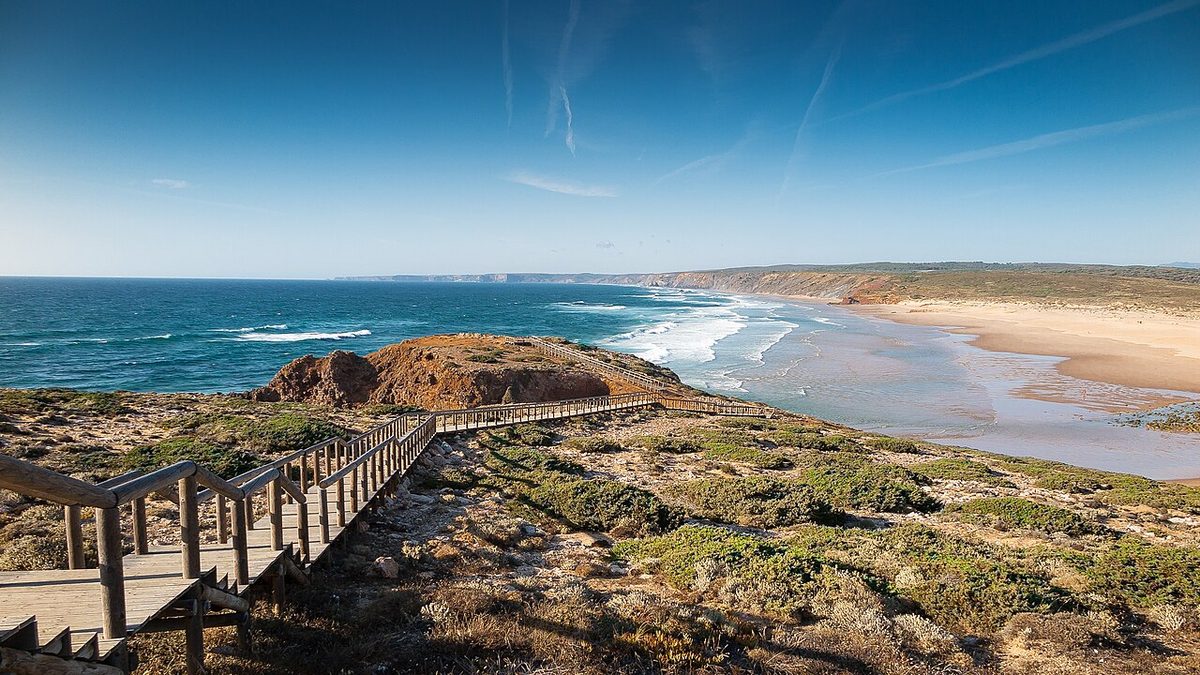
| Praia da Bordeira | West, Carrapateira | Space, dunes, surf, scenery | Boardwalk from a car park | The most beautiful beach in the Algarve |
| Praia do Amado | West, Carrapateira | Learning to surf | Track and car park, easy | Surf schools all year; cold water |
| Praia da Arrifana | West, Aljezur | Surf, a cliff-top village above | Steep road down | Dramatic; strong rips |
| Praia do Tonel & Beliche | Sagres | Big swell, sunsets | Steps | Exposed and serious |
| Praia de Dona Ana | Lagos | Stacks, clear water, photography | Long staircase | Beautiful; small; fills early |
| Praia do Camilo | Lagos | Cove and sea arch | Steep wooden staircase — see below | Access status currently disputed |
| Meia Praia | Lagos | Length, space, watersports | Flat, from town | Four kilometres; never full |
| Praia de Alvor | Alvor | Estuary boardwalk, family swimming | Flat boardwalk | Underrated all-rounder |
| Praia dos Três Irmãos | Alvor / Portimão | Rock arches with room to sit | Steps, moderate | The best balance of drama and space |
| Praia da Rocha | Portimão | A very good beach under a wall of hotels | Flat, from the promenade | Superb sand, poor setting |
| Praia do Carvalho | Near Benagil | A tunnel cut through rock to a cove | Steps and a rock tunnel | Small and memorable |
| Praia da Marinha | Near Carvoeiro | The photograph | Long staircase; car park fills by 10:00 | Genuinely worth it, at the right hour |
| Praia de Vale Centeanes | Carvoeiro | The far end of the coast path | Steps | Quieter than its neighbours |
| Praia de São Rafael | Albufeira | Stacks and clear water close to a resort | Steps | Small; early or late |
| Praia da Falésia | Olhos de Água to Vilamoura | A six-kilometre red cliff wall | Steps at intervals; flat once down | The best long beach in the region |
| Ilha Deserta | Off Faro | Almost nothing on it | Ferry only | The emptiest sand in the Algarve |
| Ilha da Culatra & Armona | Off Olhão | Sandbar villages, warm shallow water | Ferry only | The Algarve people return for |
| Praia do Barril | Off Tavira | Sand, an anchor cemetery, a little train | Footbridge then a miniature railway or a walk | The best small adventure on the coast |
| Ilha de Tavira | Off Tavira | Warm, shallow, kilometres long | Ferry | The best family beach in the Algarve |
| Praia de Cabanas | East of Tavira | Calm lagoon crossing, quiet sand | Small boat across the channel | Underrated and easy |
Three coasts, three completely different beaches
This is the part that decides whether you enjoy the holiday, and almost no beach list explains it.
| Eastern (Sotavento) | Central | Western & Costa Vicentina | |
|---|---|---|---|
| Roughly | Spanish border to Faro | Faro to Lagos | Lagos to Sagres and north |
| Beach type | Sandbar islands, lagoon, long flat sand | Limestone coves under cliffs | Wide exposed Atlantic beaches |
| Sea | Warmest and calmest in mainland Portugal | Sheltered, swimmable from about June | Cold all year; wetsuit weather in August |
| Access | Ferries and boardwalks; mostly flat | Long staircases cut into cliffs | Car parks and boardwalks; usually easy |
| Crowds | Low even in August | Very high July–August | Low outside the surf breaks |
| Best for | Families, long stays, swimming | Photography, boat trips, first visits | Surfing, walking, solitude, sunsets |
The reason the west is cold in summer is upwelling: the prevailing summer northerlies push surface water offshore and colder water rises from the deep to replace it. That is why you can stand on a west-coast beach at 30 °C and find water that takes your breath away, while the south-facing coves forty kilometres east are pleasant. The eastern lagoon shallows, warmed over a wide flat area, are warmer again. If warm, sheltered swimming is the priority and cliffs are not, Madeira is the wrong answer too — it has volcanic pools rather than beaches.
Our full Algarve guide covers the three coasts beyond their beaches, and our month-by-month guide has the underlying temperature data.
Why the Algarve’s beaches look like this
Five minutes of geology explains almost everything about this coast, including why the coves are small, why the staircases exist, why the cliffs keep falling down and why the east looks nothing like the west.
The central coast is soft limestone. The golden rock between Lagos and Albufeira is Miocene limestone, laid down as marine sediment and soft enough for the Atlantic to work on. Waves find a weakness, hollow out a sea cave, enlarge it until the roof thins, and eventually the roof collapses — which produces either a cove open to the sea or, where the collapse happened inland of the cliff face, a roofless sinkhole with a beach in the bottom. The Benagil cave with its hole in the roof is that process caught halfway through. Every one of the famous coves is a cave that has already fallen in.
Two consequences follow directly. The coves are small because a collapsed cave is small, which is why Marinha, Camilo and Dona Ana fill so fast. And the process is still running: overhangs come down without warning, and the exclusion signs at the foot of the cliffs exist because the rock above them is doing exactly what it did to make the beach you are standing on.
The east is sediment, not rock. East of Faro the limestone gives way to a system built from sand that the currents carry along the coast and deposit in a chain of barrier islands. The Ria Formosa lagoon behind them is what happens when a shoreline is protected by an offshore sandbar. The islands move, slowly, and the channels between them open and close over decades. There are no cliffs, no staircases, and no coves — just sand, water and marsh.
The west is hard rock and open ocean. Around Cape St Vincent the geology changes again to older, harder rock, and the coast turns to face the full Atlantic fetch. The beaches there are large because the waves are large: the sea has more energy, it moves more sand, and there is no shelter from the prevailing swell. That is also why the water is rough and the rips are strong.
Hold those three facts and the beach choice makes itself. Soft rock means beautiful, small and crowded. Sand means warm, flat and quiet. Hard rock and open ocean means enormous, dramatic and cold.
The famous ones, honestly assessed
Praia da Marinha
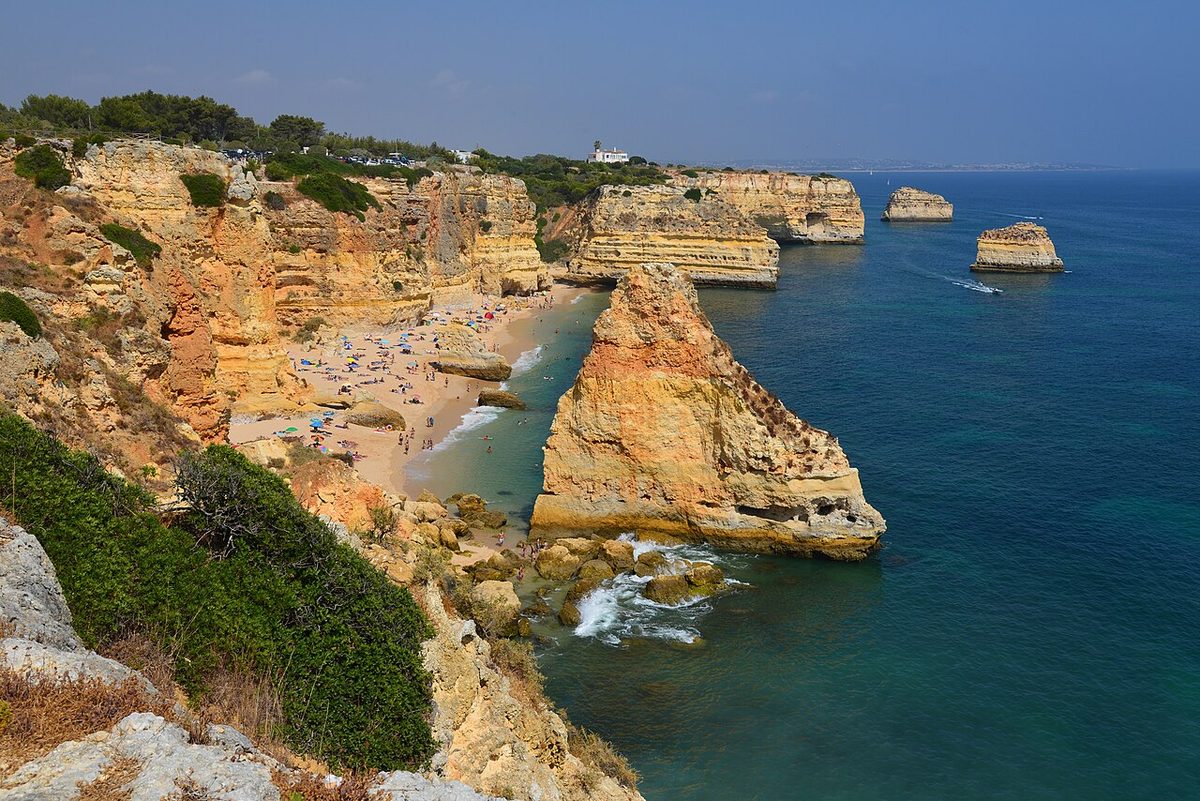
The beach on every Algarve cover: a small crescent of sand between golden cliffs with a double sea arch standing offshore, and water clear enough to snorkel in. It deserves the reputation, and it has a car park that holds a few dozen cars and a staircase that is the only way down.
The practical reality. In July and August the car park is full by about ten in the morning, the overflow parking is a long walk in full sun, and the sand below is shoulder to shoulder. At 08:30 or after 17:00 it is a different beach entirely. The clifftop viewpoint above it — where most of the photographs are actually taken — is free, always accessible, and arguably the better experience.
Verdict: go, early, and walk the coast path east from it rather than only sitting on the sand.
Praia do Camilo, and a disagreement worth knowing about
A tiny cove near Lagos reached by a long wooden staircase between cliff walls, with a rock tunnel through to a second stretch of sand and a sea arch. It is one of the most photographed beaches in Portugal and it is currently the subject of contradictory information.
Source one — a major guide updated in July 2026 — reports that access to the beach is closed following a cliff collapse, that the staircase is out of use, and that the clifftop overlook remains open. It describes this as the only closure affecting any beach on its list.
Source two — another current Algarve beach guide — describes Camilo in the present tense as a cove reached by a steep wooden staircase, with no mention of any closure.
Those cannot both be right, and neither is obviously out of date. Cliff collapses on this coast are common, closures are sometimes temporary and sometimes not, and the authority that decides is the municipality of Lagos rather than any guide. Check locally before you make the drive, and treat the clifftop viewpoint as the safe plan either way — it is where the good photograph is taken from regardless (both sources checked September 2026).
Praia de Dona Ana
Camilo’s larger neighbour, in the same cliff system south of Lagos, with sandstone stacks standing in clear water and a restaurant at the top of the staircase. It was reshaped by a sand replenishment scheme some years ago, which made it bigger and, purists say, less dramatic.
Verdict: the best combination of the classic Algarve cove look with enough sand to actually spend a day on. Arrive early; it fills.
Praia da Falésia
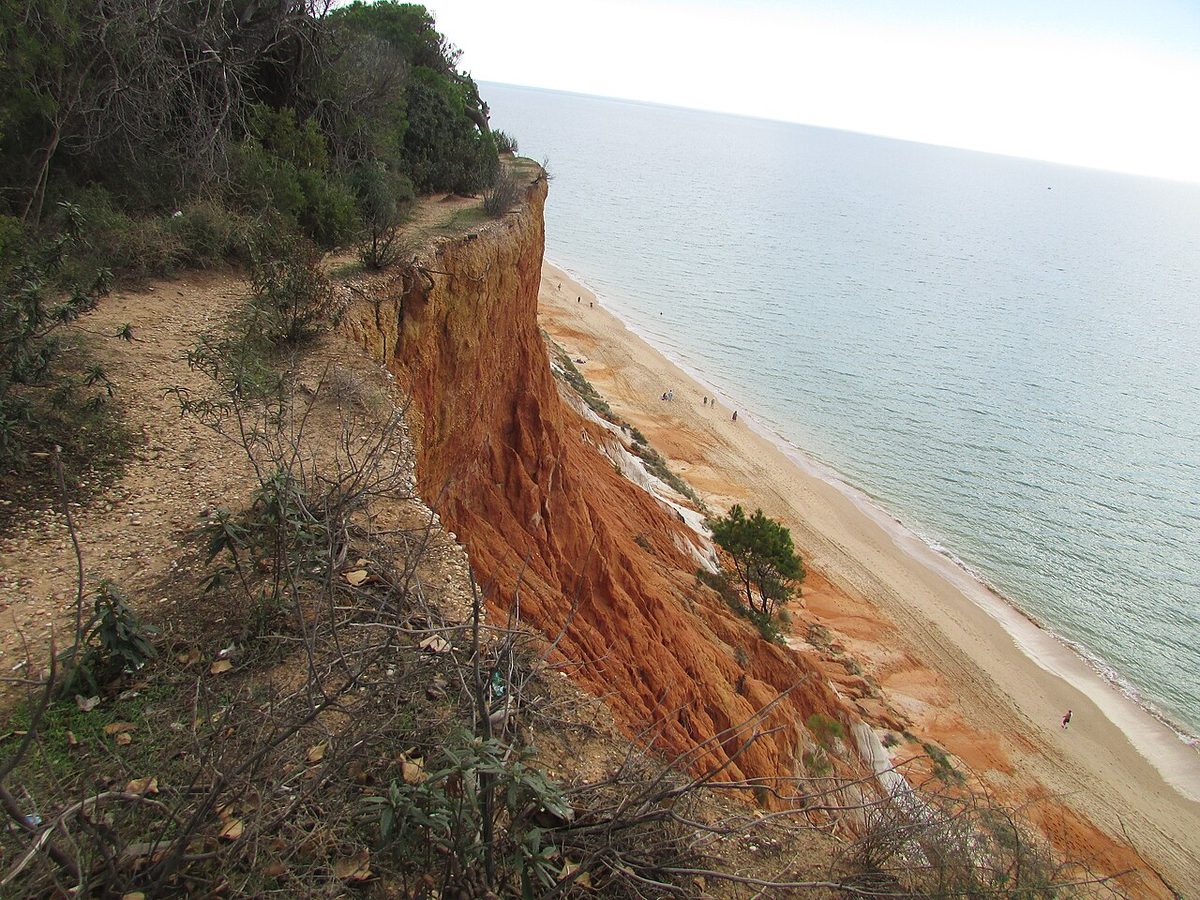
Six kilometres of sand running east from Olhos de Água towards Vilamoura, backed the whole way by a wall of eroded cliff in ochre, rust and white, topped with umbrella pines. There are staircases down at intervals, and the crucial fact is that the crowds cluster within a few hundred metres of each one — walk ten minutes in either direction and you have space.
Verdict: the best long beach in the Algarve and the right choice for anyone who finds the coves claustrophobic. It is also one of the few famous beaches here where arriving at midday in August is survivable.
Praia da Rocha
An outstanding beach — wide, long, golden, with rock stacks at the eastern end — sitting beneath a continuous wall of high-rise hotels and apartment blocks built in the 1970s and 1980s. The sand is genuinely excellent. The setting is what it is.
Verdict: walk it, swim from it, do not sleep above it unless the convenience matters more than the view. It is also one of the most accessible beaches on the coast, with flat entry from the promenade.
Praia dos Três Irmãos and Praia do Carvalho
Três Irmãos, between Alvor and Portimão, has the rock arches and stacks of the classic Algarve cove with considerably more room than Marinha or Camilo, which makes it the best all-round choice on the central coast. Carvalho, near Benagil, is reached by a staircase and then a tunnel hacked through the rock, opening on to a small cove that feels private in a way few beaches here do.
Verdict: Três Irmãos if you want to spend a day; Carvalho if you want a memorable half-hour and are already walking the coast path.
The eastern islands: the Algarve’s best-kept arrangement
From Faro east to the Spanish border, the coast is not a coast at all but a lagoon system — the Ria Formosa — separated from the sea by a chain of low sand islands. On the seaward side of each is a beach several kilometres long with warm, shallow water and no road. You get there by small ferry, which is part of the pleasure.
Ilha de Tavira
The easiest of them: a short ferry from Tavira or from Quatro Águas, landing at a strip with restaurants, sunbeds and a campsite behind, and kilometres of emptier sand in both directions. The water is shallow a long way out and among the warmest in mainland Portugal.
Verdict: the best family beach in the Algarve. Check the last ferry before you settle in.
Praia do Barril
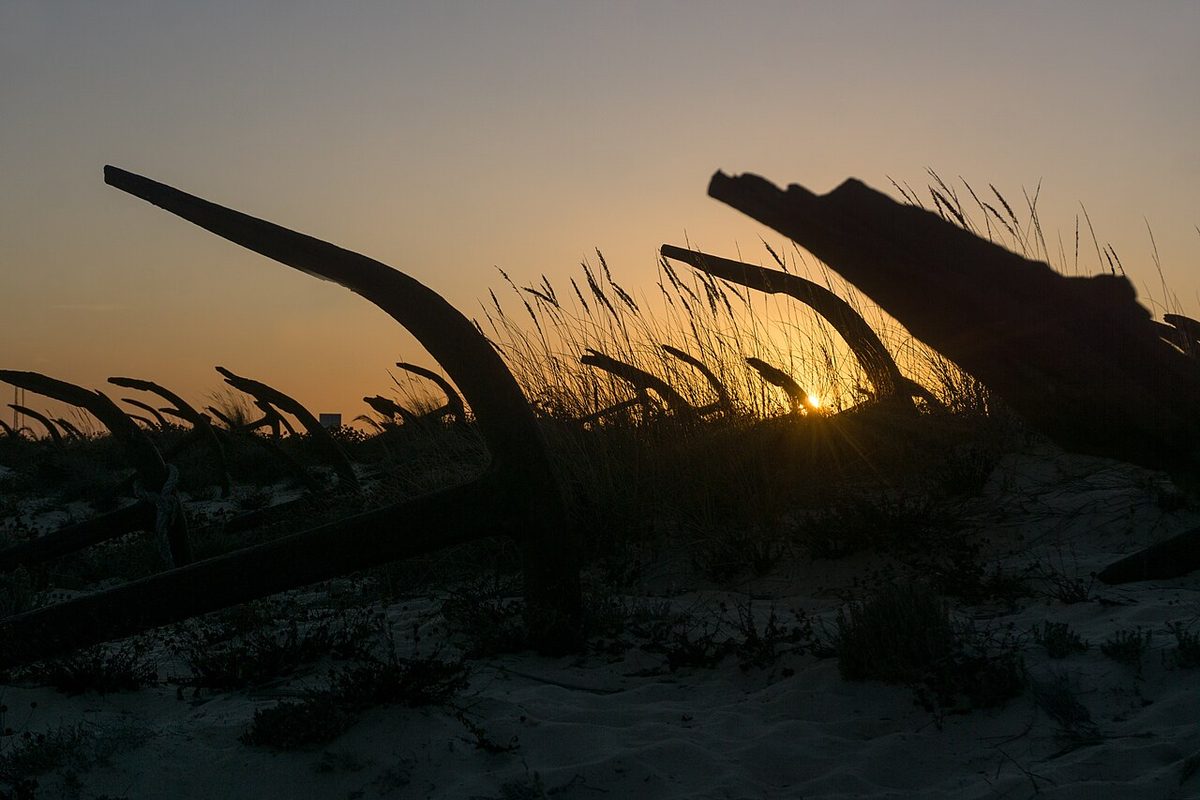
The same island, reached from Pedras d’El Rei by a footbridge over the marsh and then either a fifteen-minute walk or a miniature railway built to serve a tuna-fishing station. Behind the dunes stands the anchor cemetery: rows of rusting anchors set upright in the sand, left from the tuna fleet that worked here until the 1960s.
Verdict: the most atmospheric beach in the Algarve, and the one children remember. Go towards the end of the day, when the anchors throw long shadows.
Ilha da Culatra, Ilha da Armona and Ilha Deserta
Culatra and Armona are reached by ferry from Olhão and have small permanent communities — sand streets, no cars, a few restaurants — as well as long ocean beaches. Ilha Deserta, off Faro, has one restaurant and otherwise nothing at all, which is exactly the point.
Verdict: Armona for a beach day with a village attached, Deserta for emptiness. All three are quiet even in August, because the ferry caps how many people can be there.
Cabanas and Fuseta
Cabanas de Tavira has a small boat that crosses a narrow channel to a sandbar with several kilometres of beach; Fuseta has the same arrangement with a smaller crowd again. Both towns are pleasant, cheap and low-rise, and both are ten minutes from sand that would be famous if it were forty kilometres west.
The west coast: the best scenery and the worst swimming
West of Lagos the development thins and then stops. The coastline turns north at Cape St Vincent into a hundred kilometres of protected Atlantic seaboard where building is essentially prohibited — the Costa Vicentina. The beaches are enormous, the cliffs are high, the wind is constant and the water is cold.
Praia da Bordeira
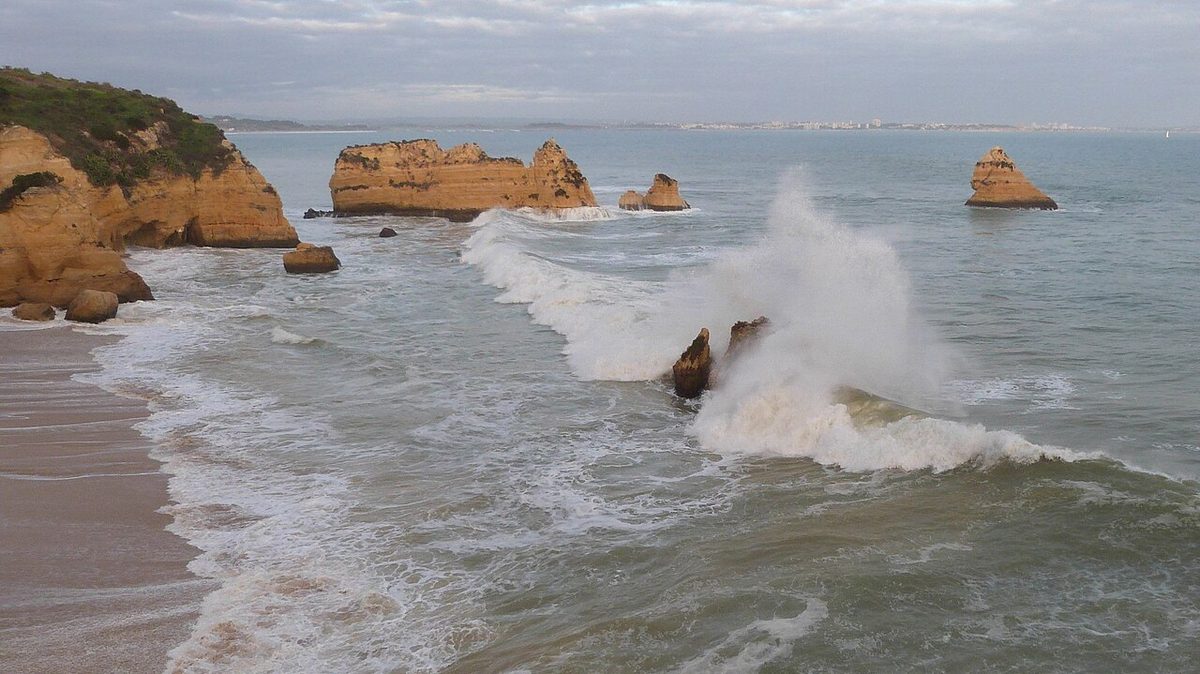
An immense beach at Carrapateira where a river meets the sea across a wide flat of sand and shallow water, with dunes behind and a boardwalk out to a headland viewpoint. At low tide the sand seems to go on indefinitely. There is nothing there but a car park and a snack bar.
Verdict: the most beautiful beach in the Algarve, and it is not a swimming beach in the ordinary sense — the shallow river channel is where families actually paddle.
Praia do Amado and Praia da Cordoama
Amado is the Algarve’s teaching beach: consistent, forgiving waves, multiple surf schools, a car park and a snack shack, and nothing else. Cordoama and Castelejo, further south, are wilder and emptier, with black cliffs and long views.
Verdict: Amado if you want a lesson, Cordoama if you want to be alone. Both are cold; a wetsuit is standard year-round.
Praia da Arrifana and Monte Clérigo
Arrifana sits in a bay below a clifftop village near Aljezur, with a serious point break and a road down that is steep enough to be memorable. Monte Clérigo has a scatter of houses above the sand and a more sheltered feel. Both are among the best sunset positions on the coast.
Verdict: Arrifana for the drama and the surf, Monte Clérigo for an actual afternoon on the sand.
Odeceixe
At the northern edge of the Algarve, the Seixe river meets the sea in a cove with cliffs on both sides, giving you a warm shallow river on one side of the sand and cold Atlantic on the other. That combination is unusual and it makes Odeceixe the one west-coast beach that genuinely works for small children.
Tonel, Beliche and the Sagres beaches
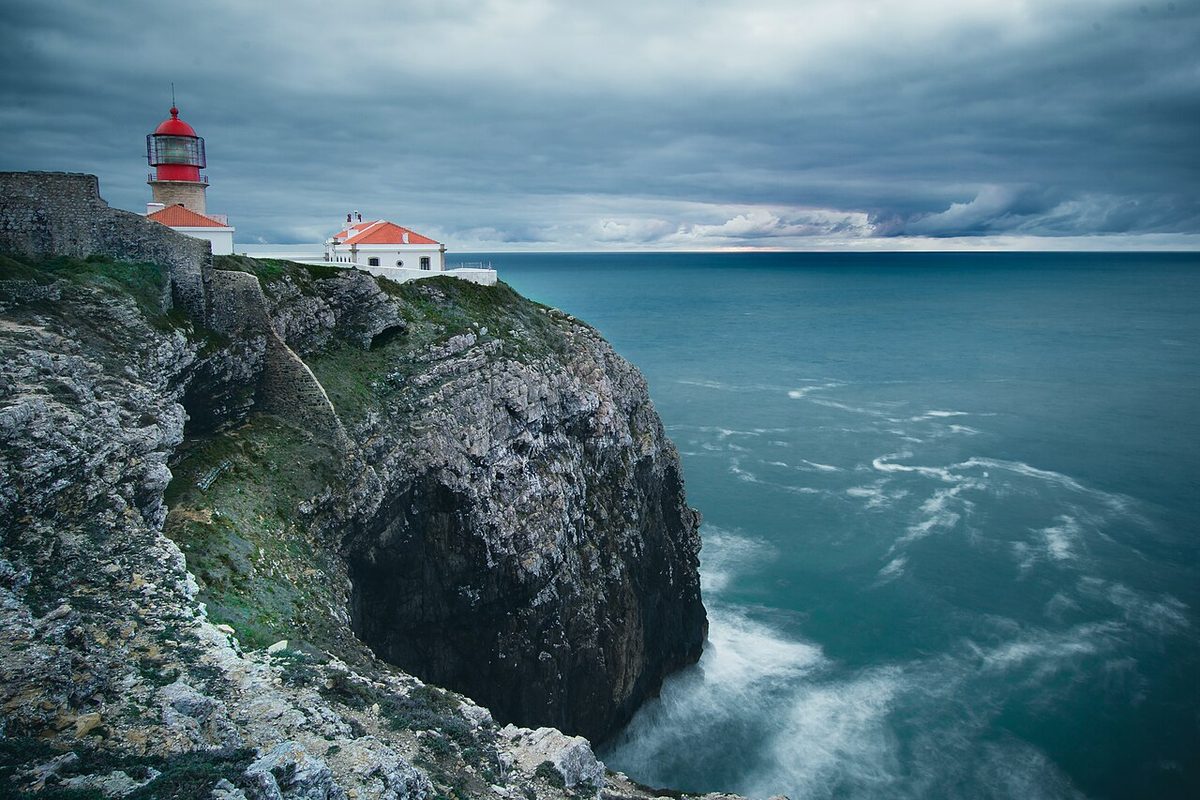
Around the south-western tip, Tonel faces west into full Atlantic swell and Beliche sits in a sheltered notch below the road to Cape St Vincent, reached by a long staircase. Both are dramatic, both are cold, and Tonel in a big swell is for surfers rather than swimmers.
Walking between beaches: the coast paths
Several of the best beaches here are better reached on foot than by car, and the paths themselves are among the finest coastal walking in Europe. This is also the reverse-season activity: the walking is at its best from October to May, when the beaches themselves are empty.
The Seven Hanging Valleys
The Percurso dos Sete Vales Suspensos runs about six kilometres one way along the clifftop between Praia da Marinha and Praia de Vale Centeanes, dipping in and out of seven valleys that end abruptly at the sea. It passes directly over the Benagil cave’s roof hole, past a collapsed sinkhole, alongside a lighthouse, and gives you access to Praia do Carvalho and several smaller coves on the way.
Practicalities: free, three hours one way, and no useful bus at the far end — so either arrange a taxi, or walk out to a turning point and back. There is no shade at all. In July it is a furnace by eleven in the morning.
Verdict: the best walk on the south coast and the single best way to understand how this coastline is put together. Stay well back from the edges, which are frequently undercut.
The Fishermen’s Trail
The coastal half of the Rota Vicentina runs north from Cape St Vincent on paths originally worn by people walking down to fish off the rocks. It is sandy, exposed and slower than the distances suggest, and it takes you along the top of the west coast’s cliffs with the beaches below. Day sections around Carrapateira, Arrifana and Odeceixe give you the experience without committing to a multi-day route.
Verdict: the finest coastal scenery in Portugal, and it needs proper shoes, water and an early start.
The eastern boardwalks
The Ria Formosa is threaded with wooden walkways across marsh and dune — at Praia do Barril, at Quinta do Lago, at Fuseta — which are flat, easy and full of birds. The Quinta do Lago boardwalk crosses a lagoon where flamingos, spoonbills and purple swamphens are routine sightings.
Verdict: the accessible option, and the best birdwatching on the coast. A completely different kind of day from the cliff paths.
Where to stay for each coast
Because the three coasts are so different, the base decides which beaches you actually reach.
| If you want | Stay in | Beaches within reach |
|---|---|---|
| The famous coves | Lagos or Carvoeiro | Dona Ana, Camilo’s viewpoint, Marinha, Carvalho, Vale Centeanes |
| Long beaches and easy access | Alvor or Praia da Rocha | Alvor, Três Irmãos, Rocha, Meia Praia |
| Warm shallow water and space | Tavira, Cabanas or Fuseta | Ilha de Tavira, Barril, Cabanas, Fuseta’s sandbar |
| Sandbar villages and quiet | Olhão | Culatra, Armona, and the lagoon boats |
| Surf and wild coast | Sagres, Aljezur or Carrapateira | Amado, Bordeira, Arrifana, Monte Clérigo, Tonel, Beliche |
| A long beach and a resort | Albufeira’s old town or Vilamoura | Falésia, São Rafael, the Albufeira town beaches |
The mistake to avoid is booking one hotel for ten days and then driving ninety minutes each way to reach different beaches. Two bases — one central and one eastern, say — give you far more coast for far less driving, and our itinerary guide sets out how the split works over a week.
Beaches sorted by what you actually need
| You want | Go to | Why |
|---|---|---|
| Warm, shallow, safe for small children | Ilha de Tavira, Cabanas, Fuseta, Odeceixe | Lagoon or river water; flat entry; short distances |
| The classic Algarve photograph | Marinha, Camilo’s viewpoint, Dona Ana | Cliffs, stacks, arches; go at 08:30 |
| Room to spread out | Falésia, Meia Praia, Bordeira, Ilha da Armona | Kilometres of sand rather than a cove |
| To learn to surf | Amado, Arrifana, Praia da Luz for beginners | Schools, consistent waves, board hire |
| Flat access, no staircase | Meia Praia, Alvor, Praia da Rocha, Falésia’s eastern end | Boardwalks and promenades rather than cliff steps |
| Almost nobody else | Ilha Deserta, Cordoama, Castelejo, Bordeira out of season | Ferry caps or long drives keep numbers down |
| Sunset | Arrifana, Monte Clérigo, Tonel, Cape St Vincent above them all | West-facing, high, and nothing beyond but ocean |
| Snorkelling | Marinha, Carvalho, Três Irmãos | Clear water and rock structure close in |
Staircases, cliffs and the safety detail lists leave out
Two things about this coast are consistently underplayed and both matter.
The staircases. A great many of the central Algarve’s best coves are reached by long wooden or concrete staircases cut into the cliff — Marinha, Camilo, Dona Ana, Carvalho, São Rafael, Beliche. That is fine going down and less fine coming back up in the afternoon heat with beach kit and a small child. It also rules these beaches out entirely for anyone with mobility problems. The flat-access alternatives are Meia Praia, Alvor, Praia da Rocha, the eastern islands and the eastern end of Falésia.
The cliffs themselves are actively eroding. These coves exist because the limestone collapses; that process has not stopped. Overhangs come down without warning, the warning signs at the top of the staircases are not decorative, and people have been killed sitting beneath them. Sit out on the open sand, well away from the cliff base, and take the same care on the clifftop paths, where the edge is often undercut and there is no barrier.
Flags and lifeguards. Portuguese beaches are patrolled during a defined bathing season, roughly June to mid-September, and outside those dates there is usually no lifeguard even on the busiest beach. Green means swimming permitted, yellow means wading only, red means the water is closed and swimming is an offence as well as a bad idea, and a chequered black and white flag means the beach is temporarily unsupervised. On the west coast, rip currents are strong and constant — if you are pulled out, swim parallel to the shore rather than against the current.
Boat trips, caves and the Benagil rules
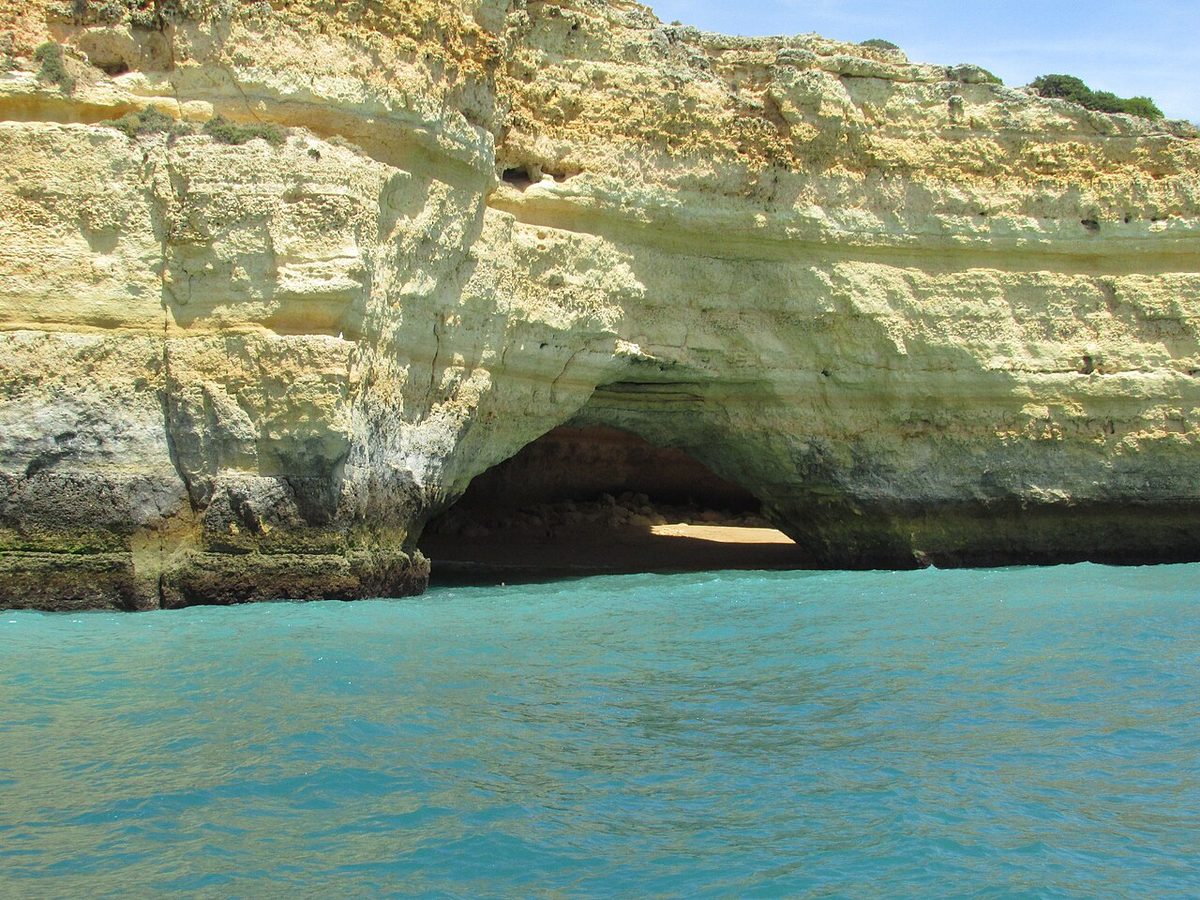
Several of the best things on this coast cannot be reached from land at all, which is why a small-boat trip along the cliffs is the single best thing you can buy in the Algarve. Take a rigid inflatable holding eight to twelve people rather than a catamaran holding eighty — the large boats cannot enter the caves, which is the entire point. Guided kayak trips run about €30–€40 a head (checked September 2026) and get closer still.
The Benagil cave rules changed and most guides have not caught up. Under the Maritime Authority’s Edital 019/2024 as amended by 009/2025, and checked in September 2026: swimming to the cave is banned with or without a flotation device; landing on the sand inside is banned; self-guided kayak and paddleboard rentals may not enter, though your own craft with a lifejacket is permitted. Guided kayak groups run one guide per six kayaks. Motorised boats stay roughly fifteen metres off and enter by the western arch; non-motorised craft use the eastern. Each group gets five to ten minutes inside, and operator fines run from €300 to €216,000.
The consequence is that the famous photograph of one person standing alone on the sand inside the dome is no longer a legal image to recreate. What you can still do is enter by boat or guided kayak and look up through the roof hole, which is the thing worth doing anyway.
When to go, and how warm the water actually is
The Algarve has one of the longest beach seasons in Europe and the sea lags the air by months.
| Period | Air | Sea | Crowds | Verdict |
|---|---|---|---|---|
| April–May | Pleasant, 20–23 °C | Still cold | Low | Best for coast walking, not swimming |
| June | Reliably warm | Swimmable in the south and east | Filling | The sweet spot before the peak |
| July–August | Hot, up to 29 °C at Faro | Warm in the south, cold in the west | Peak | Early mornings only at the famous coves |
| September | 25–29 °C | Warmest of the year | Falls after week one | The best month, narrowly |
| October | 21–25 °C | Still swimmable | Low | Excellent value |
| November–March | 15–18 °C, sunny spells | Cold | Very low | Walking and empty sand; not swimming |
September wins because the Atlantic takes all summer to absorb heat, which is why the warmest water of the year arrives when the crowds are leaving. The east warms earliest and stays warm longest; the west never really warms at all.
Beaches for a winter visit
Between November and March the Algarve’s beaches empty completely and become a different proposition, which almost no beach list acknowledges. The sea is cold and unpatrolled, so swimming is out for most people. Everything else improves.
Praia da Falesia at low tide in January is six kilometres of hard sand with almost nobody on it, and the low winter sun makes the ochre cliff wall behave in a way it never does at midday in July. Bordeira and Amado get their winter swell, which is when the surfers arrive and the beaches look their most dramatic. The eastern islands run a reduced ferry service and reward it with genuine emptiness. And Praia da Marinha, which is unbearable in August, is simply one of the loveliest places in Europe on a clear December morning with six people on it.
Two practical notes. Many beach restaurants and concessions close from about November to March, particularly on the west coast, so take food and water. And the winter Atlantic reshapes this coast — sand shifts, staircases get damaged and cliff falls are more likely after heavy rain, so access that worked in September may not work in February.
Verdict: if you can accept that swimming is off the table, the winter Algarve beach is better than the summer one in every respect except the water. Our month-by-month guide has the temperature and rainfall figures behind that.
What to skip: the overrated beaches and the classic mistakes
Marinha at midday in August
The car park holds a few dozen cars and fills by ten. The overflow is a long walk in full sun and the sand below is shoulder to shoulder. Go at 08:30 or at 17:00, or walk in along the coast path from Benagil. The beach has not got worse; the timing has.
Any cove with a staircase, if stairs are a problem
Not a criticism of the beaches, just an honest constraint. If a long staircase in afternoon heat is not realistic for you or your group, do not spend the day driving to five of them. Base the trip on the eastern islands and the flat-access beaches instead.
The big catamaran cave cruises
They cannot enter the caves. The marketing photographs are all shot from small craft. Pay a little more for a rigid inflatable or a guided kayak.
Assuming the west coast is a swimming coast
Cold, rough, rip-prone. People arrive at Bordeira or Cordoama expecting the water they had at Albufeira and get an unpleasant surprise, or worse. These are walking, surfing and looking beaches.
Praia da Rocha as a base rather than a visit
Superb sand, a wall of high-rise behind it. Visit for a walk and a swim; sleep in Alvor, Lagos or Carvoeiro, all within twenty minutes, where the town survived the building boom.
Chasing a beach you saw on the internet without checking access
This coast changes. Staircases close after cliff falls, car parks get capped in summer, and a cove that was accessible last season may not be this one — the current confusion over Praia do Camilo is exactly that situation. Check the municipality’s information before a long drive.
Practical notes
Parking at the famous coves is limited and free, which is a bad combination in August — arrive before ten or after five. The bigger beaches at Falésia, Meia Praia and Praia da Rocha have paid car parks that usually have space.
Blue Flags. The Algarve holds one of the highest counts of any European region, and the award certifies water quality and facilities rather than beauty. Several of the loveliest coves have no flag because they have no lifeguard hut or accessible path, so do not use it as a ranking.
Dogs are prohibited on most supervised beaches during the bathing season and permitted out of season, with a small number of designated dog beaches year-round. The municipal websites list them and enforcement is real.
Naturism is legal on a handful of officially designated beaches, of which Praia da Adega near Albufeira and stretches of Ilha Deserta and Barril are the best known. Elsewhere it is tolerated in remote spots and not on family beaches.
Facilities vary enormously. The eastern islands have a restaurant or two and little else; the west-coast beaches often have a snack bar and a toilet block; the central coves range from a full beach club to nothing at all. Take water for the west and the islands.
Eating on the beach, and the price of a sunbed
The Algarve beach economy runs on three things and it is worth knowing what each costs before you commit to a day.
The beach restaurant. Most supervised beaches have one, and the quality ranges from a shack grilling sardines to a serious fish restaurant with a terrace. The universal rule applies here as everywhere in Portugal: fish is frequently priced by the kilogram rather than the portion, so ask what the piece you are being shown will actually cost before you agree to it. That is not a scam, it is how fish is sold, and it accounts for most of the surprised faces at the end of a beach lunch.
The sunbed and parasol. Rented in pairs on the busier beaches, and the price varies with how popular the beach is rather than with what you get. On the eastern islands it is modest; at the famous central coves in August it is not. Nobody minds if you lay a towel on the sand instead, and on the quieter beaches there is no concession at all.
The snack bar. On the west coast and the islands this is often the only facility, and several of them close entirely outside the bathing season. Take water for any west-coast or island beach, and do not assume there will be a toilet.
General Portuguese pricing holds: a set lunch inland runs €9–€15, grilled fish on the coast €15–€25 a head, and a coffee at a counter €0.80–€1.20 (checked September 2026). The beachfront premium is real and is usually about a third, which one street back removes entirely.
Getting to the beaches
By car, which is how most people reach the central and western beaches. Parking at the famous coves is free and limited, which in August means arriving before ten or after five. The A22 motorway that runs the length of the region is electronic-toll only with no booths — take the transponder the hire company offers, because without it charges are matched to the number plate and reach you weeks later with administration fees attached.
By train, which is underrated. The regional line runs from Lagos to Vila Real de Santo António via Portimão, Albufeira, Faro and Tavira, is cheap and slow, and puts you within walking distance or a short taxi of a surprising number of beaches — Meia Praia at Lagos, the Tavira and Cabanas ferries, and Fuseta among them.
By ferry, which is the only way to reach the eastern islands. Boats run from Tavira, Quatro Águas, Cabanas, Fuseta, Olhão and Faro, more frequently in summer than in winter, and the crossings take between five and thirty minutes. The last departure back is the thing to check before you settle in for the afternoon, because they stop earlier than you expect outside high season.
On foot, which is the best way to reach several of the central coves — Carvalho and the smaller beaches along the Seven Hanging Valleys path have no car park at all, and walking in from Benagil or Marinha is both the intended route and the pleasant one.
Frequently asked questions
What is the best beach in the Algarve?
Praia da Marinha for the classic scenery, if you go at 08:30 rather than midday. Praia da Bordeira for the finest landscape, if you accept that the swimming is cold and shallow. Ilha de Tavira for the best day on the sand, if what you want is warm water and space. There is no single answer because the three coasts are genuinely different products.
Is Praia do Camilo open?
Sources disagree as of September 2026. A major guide updated in July 2026 reports the beach access closed after a cliff collapse with the clifftop overlook still open; another current guide describes the staircase in use with no mention of a closure. Cliff falls here are common and closures can be temporary, so check with the municipality of Lagos before driving out. The viewpoint above is where the photograph is taken from in any case.
Which part of the Algarve has the best beaches?
The central coast between Lagos and Albufeira has the famous limestone coves. The eastern lagoon has the warmest, calmest and least crowded sand. The west has the best scenery and the coldest water. For a first visit take the centre; for a family week take the east; for walking and surfing take the west.
Where is the warmest sea in the Algarve?
The eastern lagoon — the sandbar beaches off Tavira, Olhão, Cabanas and Fuseta — where shallow water over a wide flat area warms considerably more than the open coast. The west coast, from Sagres northwards, is the coldest, because summer upwelling brings deep water to the surface.
Which Algarve beaches are best for families?
Ilha de Tavira, Cabanas, Fuseta and Praia do Barril in the east, for warm shallow water and flat access. Odeceixe on the west coast, because the river gives you warm water alongside the cold sea. Meia Praia and Alvor in the centre, both flat and large. Avoid basing a family week around the cliff coves, which mean a long staircase every time.
Can you still swim into the Benagil cave?
No. Swimming to the cave is banned with or without a float, landing on the sand inside is banned, and self-guided kayak or paddleboard rentals may not enter, under the Maritime Authority’s Edital 019/2024 as amended in 2025 (checked September 2026). You can enter by boat or on a guided kayak, with five to ten minutes inside per group.
Do you need a car to reach the best Algarve beaches?
For the central coves and the west coast, effectively yes. For the eastern islands, no — Tavira, Cabanas, Fuseta and Olhão are all on the coastal train line and the ferries leave from the towns. Lagos is also on the train and has Meia Praia, Dona Ana and Camilo’s viewpoint within walking or a short taxi.
When is the best time to visit Algarve beaches?
Late September for the warmest sea and thinning crowds, then June for reliable sun before the peak, then October for value. July and August have the best weather and the worst crowding at the famous coves, where the car parks fill by mid-morning.
Are Algarve beaches safe for swimming?
The central and eastern beaches, generally yes, within the flagged and patrolled areas during the bathing season. The west coast has strong rip currents and cold water and demands more care. The real hazards are rips on the west and cliff falls everywhere — sit away from the cliff base, and take red flags literally.
Which Algarve beach has the fewest people?
Ilha Deserta off Faro, which has one restaurant and is reached only by boat. On the mainland, Cordoama and Castelejo on the west coast, and Bordeira outside July and August. The ferry-only islands stay quiet in high season precisely because the boats limit numbers.
Is Praia da Falésia worth visiting?
Yes, and it is the answer for anyone who finds the coves cramped: six kilometres of sand under an ochre and rust-coloured cliff wall, with staircases down at intervals. Crowds cluster near each staircase, so a ten-minute walk in either direction buys you space even in August.
What should I take to an Algarve beach?
Water, especially on the west coast and the islands where facilities are minimal. Shade of some kind, because several of the best beaches have none and sitting under the cliff is genuinely dangerous. Shoes you can manage a long staircase in. And cash for the smaller beach bars, several of which still prefer it.
Which is the most beautiful beach in Portugal?
Praia da Marinha usually takes that title on the south coast, and Praia da Bordeira is the better answer if landscape rather than photogenic detail is what you mean. Outside the Algarve, the Arrábida coves south of Lisbon and the sandbars of the Ria Formosa both have a claim, and none of them is a swimming beach in the same sense.
Are there sandy beaches in the eastern Algarve?
The eastern Algarve is almost entirely sandy — the barrier islands off Tavira, Olhão, Cabanas and Fuseta carry kilometres of continuous beach with no cliffs at all. The catch is that most of it is reachable only by small ferry, which is precisely why it stays quiet in August.
Do Algarve beaches have lifeguards out of season?
Generally no. The patrolled bathing season runs roughly from June to mid-September, and outside those dates even the busiest beaches are usually unsupervised. That matters most on the west coast, where the rip currents do not take the winter off.
Can you walk between Algarve beaches?
On the central coast, yes and it is the best thing to do there — the Seven Hanging Valleys path links Praia da Marinha to Vale Centeanes over about six kilometres of clifftop, passing several coves. On the west, the Fishermen’s Trail links the beaches along the Costa Vicentina. In the east, boardwalks cross the marsh rather than linking beaches, because the beaches are all on offshore islands.
How much does a day at an Algarve beach cost?
The beach itself is free everywhere; Portugal has no private beaches. The costs are parking (free but limited at the famous coves, paid at the big resort beaches), sunbeds and parasols where a concession operates, and lunch at €15–€25 a head for grilled fish or less at a snack bar (checked September 2026). A boat trip along the cliffs adds €30–€40 for a guided kayak.
Which Algarve beach is best for sunset?
The west coast, because it faces the Atlantic: Arrifana, Monte Clérigo and Praia do Tonel all work, and Cape St Vincent above them is where a couple of hundred people gather every evening. On the south coast the sun sets over the sea only at the western end, which is why Lagos and Sagres get the good evenings and Tavira does not.
Once you’ve settled on a stretch of coast, our where to stay in Algarve guide covers which towns actually work as a base for it, from the resort belt around Albufeira and Vilamoura to the quieter eastern islands off Tavira.
If the Algarve isn’t the whole trip, our best beaches in Portugal guide sets these coves alongside the other five coasts — the Lisbon surf beaches, the Silver Coast’s big waves, the wild Alentejo, the north and the islands.
Where to go next
The beaches are one part of the region. Our full Algarve guide covers the towns, the interior, the coast paths and where to base yourself for each coast, and our region-by-region guide to Portugal sets the south against the rest of the country.
For fitting a beach week into a longer trip, our day-by-day itinerary hub explains why the Algarve needs four nights rather than a lunge south from the capital, and our month-by-month guide has the climate data behind the timing advice above. If you are starting in the capital, we have full guides to Lisbon and its day-trip belt.
Photo credits
- The boardwalk above Praia da Bordeira at Carrapateira on the Costa Vicentina — Paulo Valdivieso from Lisboa, Portugal, CC BY-SA 2.0, via Wikimedia Commons
- The ochre cliff wall running above Praia da Falésia at Olhos de Água — Kolforn, CC BY-SA 4.0, via Wikimedia Commons
- The anchor cemetery in the dunes behind Praia do Barril near Tavira — Alexey Komarov, CC BY-SA 4.0, via Wikimedia Commons
All prices, rules and access arrangements were checked in September 2026 against the operators’ sites and the Maritime Authority’s published editais. This coast changes: cliff falls close staircases, and the Benagil restrictions have been amended twice since 2024. Confirm access with the local municipality before a long drive. Last updated: 18 September 2026.