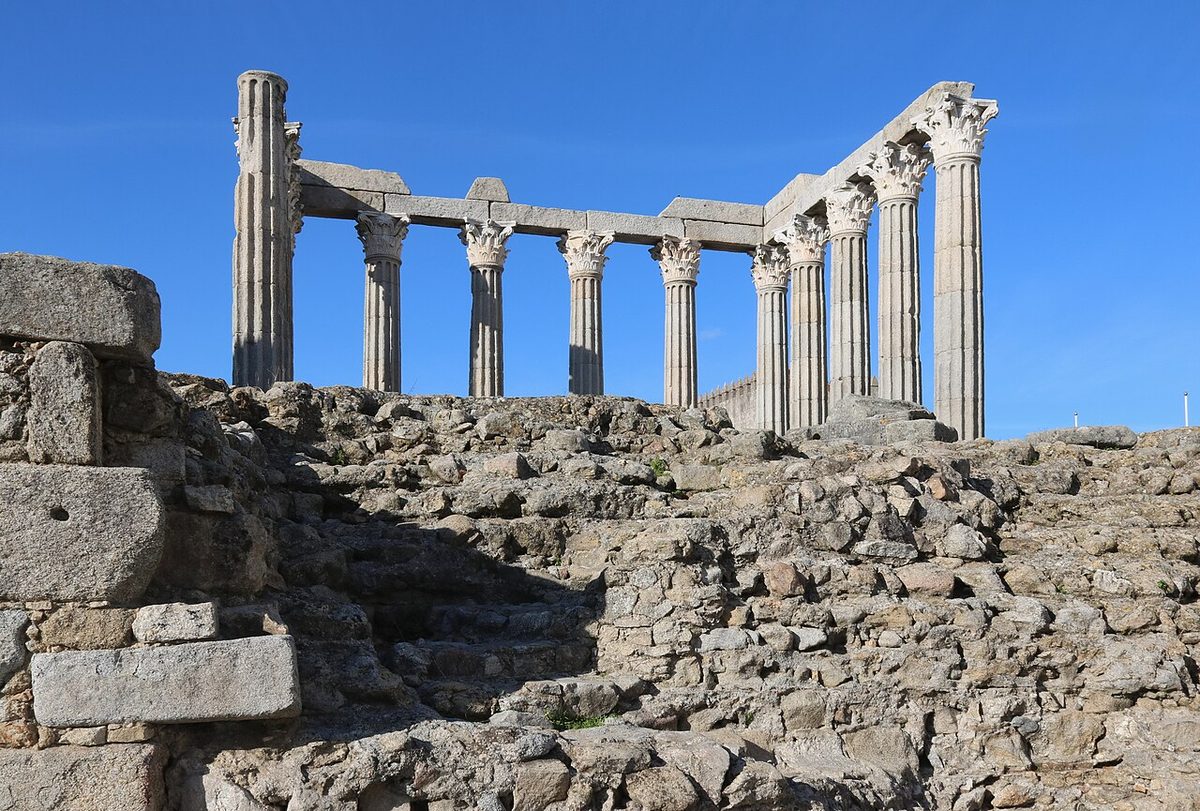
Most Portugal itinerary guides are a list of places in the order the writer happened to visit them, with the transport left as an exercise for the reader. That is the wrong shape, because in Portugal the transport is the itinerary. The country is small and slow: Lisbon to Porto is under three hours by train and Lisbon to Faro is three hours by road, but the Douro line runs twice a day, the Algarve’s best beaches are forty minutes apart on winding lanes, and the islands need flights that eat two days of any fortnight.
The short answer: a good Portugal itinerary picks one of three shapes. Seven days does Lisbon and Porto with the Douro, by train, and nothing else. Ten days adds either the Alentejo and the Algarve going south, or Coimbra and the coast going north. Fourteen days does the whole mainland properly, or one week of mainland plus one island. Trying for all of it in ten days is the single most common mistake.
What follows is four itineraries — five, seven, ten and fourteen days — each with a day-by-day table, the actual transport connection between each stop with times and fares where they are published, and a variant for people who do not want to drive. There are also island routes, a section on what to cut, and an honest account of which famous stops are not worth the transfer. Fares and prices were checked in September 2026 on the operators’ own sites.
Before the routes: the three shapes a Portugal itinerary can take
Every good trip here is a version of one of three geometries, and choosing the wrong one is what makes people spend their holiday in a car.
| Shape | How it works | Best for | Transport | Weakness |
|---|---|---|---|---|
| The corridor | Lisbon and Porto with the middle in between, on the north–south axis | First visits, 7–10 days, no car | Train, almost entirely | Misses the Algarve and the Alentejo |
| The full sweep | Porto down to the Algarve, or the reverse | 10–14 days, road trip | Hire car; one-way drop fees apply | Long driving days; nothing seen twice |
| Two bases | One city and one region, with day trips from each | 5–9 days, families, slow travellers | Train between the two, taxis locally | Sees less of the country |
| Mainland plus island | One week on the mainland, one on Madeira or in the Azores | 14 days, second visits | Train plus one internal flight | Two travel days lost to airports |
The single most useful planning fact: Portugal’s two big cities are connected by a fast, frequent, cheap train, and almost everything else is not. The Alfa Pendular runs Lisbon to Porto in 2h39–2h50 for €35.70 in tourist class or €49.90 in Conforto, with 15 to 19 departures a day, and promotional fares from around €16 released up to sixty days ahead (cp.pt, checked September 2026). Any itinerary built on that spine works without a car. Any itinerary that leaves the spine needs one.
How many days do you actually need?
Honest answers, based on how long each region takes to see rather than how long you can survive there.
| Days on the ground | What fits comfortably | What does not |
|---|---|---|
| 3–4 | Lisbon and Sintra, or Porto and the Douro | Both cities; any island |
| 5 | Lisbon plus Porto, fast; or one region properly | The Algarve as well |
| 7 | The corridor: Lisbon, Porto, the Douro, one town in between | The Algarve, the Alentejo, the islands |
| 10 | The corridor plus one of: the Algarve, the Alentejo, the central coast | All three; the islands |
| 14 | The whole mainland at a civilised pace, or one week mainland and one island | Both island groups |
| 21 | Mainland plus Madeira, or mainland plus the Azores with island hopping | Not much |
“Days on the ground” excludes your arrival and departure days, which are usually half-days at best. A “ten-day trip” with flights on day one and day ten is really eight days, and building an itinerary as though it were ten is how people end up eating dinner at a motorway service station.
Trains, cars and buses: what each route actually needs
The transport decision comes before the destination decision, because it constrains what is reachable.
The train network
Portugal’s railway is good on the north–south main line and thin everywhere else. The Lisbon–Coimbra–Porto spine is fast and frequent. Branches to Braga, Guimarães, Aveiro and the Algarve coast work well. The Douro line east from Porto is scenic and infrequent. Almost everything else — the Alentejo interior, the Algarve’s inland towns, most of the coast between Lisbon and Porto — is either bus territory or car territory.
| Leg | Service | Time | Fare | Notes |
|---|---|---|---|---|
| Lisbon → Porto | Alfa Pendular | 2h39–2h50 | €35.70 tourist / €49.90 Conforto | 15–19 a day from Santa Apolónia and Oriente |
| Lisbon → Porto | Intercidades | ~20 min slower | ~€28.05 | The value option |
| Either of the above | Promotional fare | — | from ~€16 | Released up to 60 days ahead, non-refundable, sells out |
| Porto São Bento → Pinhão | Linha do Douro regional | ~2h20 | ~€12.45 | Only about two direct services a day, roughly 09:25 and 13:25 |
Fares and times checked on cp.pt in September 2026. For legs not listed here, check cp.pt directly rather than trusting a figure in any guide — regional fares in particular change without much notice.
Two operational details that matter. Long-distance trains have reserved seating and do sell out on Friday and Sunday evenings and around public holidays, so book those legs ahead. And Lisbon has two long-distance stations — Santa Apolónia, at the eastern edge of the old centre, and Oriente, out at Parque das Nações — with most northbound services calling at both; Oriente is closer to the airport and Santa Apolónia is closer to almost everywhere you will want to sleep.
Hiring a car
A mid-season week runs €180–€300 plus fuel and tolls (checked September 2026). The car is genuinely necessary for the Alentejo, the Algarve away from the coastal train, the interior, the Costa Vicentina and Peneda-Gerês. It is a liability in Lisbon and Porto, where the old centres are restricted, narrow and expensive to park in.
The rule that follows: collect the car on the morning you leave the city, and drop it before you arrive in the next one. On a Porto-to-Algarve route that means paying a one-way drop fee, which is worth it against three days of city parking.
Tolls. Several Portuguese motorways — the A22 across the Algarve, the A23, and others — are electronic-only with no booths. You cannot pay cash. Take the transponder the hire company offers; without it the charges are matched to the number plate and reach you weeks later with administration fees on top. This is the most common administrative mistake visitors make in Portugal.
Buses
Long-distance coaches cover what the trains do not, particularly the Alentejo and the smaller Algarve towns, and they are cheap and comfortable. They are also slower and less frequent than the equivalent train, and the journey time to somewhere like Évora or Óbidos makes them a day-trip tool rather than an itinerary spine.
The 5-day Portugal itinerary
Five days on the ground is enough for one city and its surroundings done properly, or for both big cities done briskly. It is not enough for the Algarve as well, and every attempt to fit it in produces a bad trip.
Option A: Lisbon and Porto, by train
The efficient version. Two bases, one train journey, no car.
| Day | Base | Plan | Transport |
|---|---|---|---|
| 1 | Lisbon | Alfama from 09:00, the castle or the free viewpoints, Baixa and the river arch, fado in the evening | Walking; metro from the airport |
| 2 | Lisbon | Belém at opening: the monastery cloister, the tower from outside, one museum, pastéis de nata | Tram 15E or the train from Cais do Sodré |
| 3 | Lisbon | Sintra: Pena with a timed ticket, then Quinta da Regaleira or the town | Train from Rossio, ~40 min |
| 4 | Porto | Morning train north; São Bento, the Baixa hill, Livraria Lello, the Ribeira; sunset on the bridge | Alfa Pendular 2h39–2h50, €35.70 |
| 5 | Porto | Cross to Gaia for one port lodge; Serra do Pilar; Jardim do Morro at sunset | Walking and the cable car |
What this misses: the Douro valley, which needs a whole day and is the best thing in northern Portugal. If you can add a sixth day, add it here rather than anywhere else.
Option B: Lisbon and the Alentejo, by car
The slower and, for some people, better version — two nights in the capital and three in a part of the country almost no short trip reaches.
| Day | Base | Plan | Transport |
|---|---|---|---|
| 1 | Lisbon | Alfama, the viewpoints, the Baixa grid, dinner in Príncipe Real | Walking |
| 2 | Lisbon | Belém in the morning, Chiado and Bairro Alto in the afternoon and evening | Walking and tram |
| 3 | Évora | Collect the car; drive east; Roman temple, cathedral roof, the bone chapel, a long Alentejo lunch | ~1h30 by road from Lisbon |
| 4 | Évora or Monsaraz | Wine estates, Monsaraz on its hill, the Alqueva lake and dark skies after dark | Car, short distances |
| 5 | Lisbon | Return via Arraiolos or Estremoz; drop the car at the airport | Car |
Why this works: the Alentejo is the cheapest and emptiest region in mainland Portugal, the drives are short, and Alqueva is the world’s first certified Starlight Tourism Destination, which is a real distinction and not a marketing line — the sky there is genuinely dark.
The 7-day Portugal itinerary
Seven days is the length at which Portugal starts to make sense. It is exactly enough for the corridor — the two cities, the Douro and one stop in between — and not enough for anything more.
The classic: Lisbon, the centre, Porto and the Douro
This is the itinerary I would give almost any first-time visitor. It can be done entirely by train, which removes the parking problem in both cities.
| Day | Base | Plan | Transport |
|---|---|---|---|
| 1 | Lisbon | Arrive; Alfama and the viewpoints in the afternoon; fado after 21:30 | Metro from the airport, ~25 min |
| 2 | Lisbon | Belém at opening; the Coach Museum or MAAT; Chiado and Bairro Alto in the evening | Tram 15E; walking |
| 3 | Lisbon | Sintra: Pena timed ticket, Regaleira, the Vila Sassetti footpath rather than the 434 bus | Train from Rossio, ~40 min |
| 4 | Coimbra | Morning train; the university on its hill, the Joanina library, the old town; overnight | Train from Lisbon, on the main line |
| 5 | Porto | Short train north; São Bento, Clérigos, Lello, the tiled churches; Ribeira at sunset | Train from Coimbra, on the main line |
| 6 | Porto | Gaia: one port lodge booked ahead, the Serra do Pilar cloister, the cable car down | Walking, cable car |
| 7 | Douro valley | The 09:25 from São Bento to Pinhão, right-hand side; a quinta or lunch by the river; back in the evening | Linha do Douro, ~2h20, ~€12.45 |
The one substitution worth making: if Coimbra does not appeal, spend the night in Aveiro instead and take the bus out to the striped houses at Costa Nova, or stay a second night in Lisbon and go straight to Porto on day five. Coimbra is the more interesting town and Aveiro is the prettier afternoon.
The alternative: Lisbon and the Algarve
For anyone who wants sun rather than cities, or is travelling with children who will not tolerate a fourth cathedral.
| Day | Base | Plan | Transport |
|---|---|---|---|
| 1–3 | Lisbon | Alfama, Belém, Sintra — as above, three nights | Train and walking |
| 4 | Lagos or Carvoeiro | South in the morning; afternoon on a beach; dinner in the old town | ~3h by road, 280 km; or train to Lagos |
| 5 | Central Algarve | Small-boat cave trip along the cliffs, booked for the morning; Praia da Marinha in the late afternoon | Car or transfer |
| 6 | Central Algarve | Seven Hanging Valleys coast path early; Silves castle in the afternoon | Car |
| 7 | Faro | Ilha Deserta or Faro old town; evening flight home | Ferry; car drop at the airport |
The honest verdict: this is a good holiday and a poor introduction to Portugal, because it skips the north entirely. If it is your first visit and you have only seven days, take the corridor. If it is your second, or if the point is the beach, take this.
Doing the seven days without a car
Entirely possible for the corridor version, which is one of the reasons to prefer it. For the Algarve version, the coastal train runs from Lisbon to Lagos and along the whole southern coast, and it puts you within a taxi ride of most of the towns worth staying in. What you lose is the Seven Hanging Valleys trailhead, the inland towns and the west coast — so a carless Algarve week should be based in Lagos or Tavira, both of which are walkable towns with a station.
The 10-day Portugal itinerary
Ten days is the length most people search for and the one where the trade-offs get real. You can add exactly one region to the corridor. Which one you add is the whole decision, and the three sensible answers are the Algarve, the Alentejo, or the central coast between the cities.
Option A: north to south, the full sweep
The classic road trip. Fly into Porto, out of Faro, and never double back. This is the version that needs a car and a one-way drop fee, and it is the best single use of ten days in Portugal.
| Day | Base | Plan | Transport |
|---|---|---|---|
| 1 | Porto | Arrive; São Bento, the Ribeira, the upper deck of the bridge at sunset | Metro line E from the airport, ~30 min |
| 2 | Porto | The Baixa hill: Clérigos, Lello, the tiled churches, Bolhão; Gaia and one port lodge in the afternoon | Walking, cable car |
| 3 | Douro valley | The early train to Pinhão; a quinta visit; overnight in the valley or back to Porto | Linha do Douro, ~2h20, ~€12.45 |
| 4 | Coimbra | Collect the car; drive south; the university, the Joanina library, an evening of student fado | ~1h30 from Porto by road |
| 5 | Nazaré or Óbidos | The monastery triangle — Alcobaça, Batalha, Tomar — then the coast; €6–€10 entry each | Car; short hops |
| 6 | Lisbon | Drop the car; Alfama, the viewpoints, the Baixa grid, fado | ~1h from Óbidos by road |
| 7 | Lisbon | Belém at opening; Chiado in the afternoon; dinner in Príncipe Real | Walking, tram |
| 8 | Lisbon | Sintra with a timed Pena ticket, or Évora as a longer day out | Train from Rossio, ~40 min |
| 9 | Algarve | Collect a car again and drive south; afternoon on a central Algarve beach | 280 km, ~3h; A2 and A22 tolls |
| 10 | Algarve | Morning cave boat trip; Praia da Marinha late; evening flight from Faro | Car drop at Faro airport |
Two warnings about this route. First, days 9 and 10 are thin — you get roughly a day and a half in the Algarve, which is not enough to justify the transfer for most people. Second, hiring a car twice costs more than hiring it once and paying for city parking, so price both before you book.
The fix for both is to cut the Algarve and give the extra two days to the centre. Which brings us to the version I would actually recommend.
Option B: the corridor, properly, with the centre
Same ten days, no rush, and it covers the part of Portugal that visitors most consistently regret skipping. The whole thing works by train plus two days of car hire.
| Day | Base | Plan | Transport |
|---|---|---|---|
| 1 | Lisbon | Arrive; Alfama, Portas do Sol, Senhora do Monte at sunset | Metro from the airport |
| 2 | Lisbon | Belém at opening; the Coach Museum; Cais do Sodré in the evening | Tram 15E |
| 3 | Lisbon | Sintra: Pena timed ticket, Regaleira, the Vila Sassetti path | Train from Rossio |
| 4 | Lisbon | Évora as a full day, or Setúbal and Arrábida for dolphins and white-sand coves | Bus or train, ~1h30; or ferry and bus |
| 5 | Óbidos / Nazaré | Collect the car; walled Óbidos early before the coaches; Nazaré and the Praia do Norte clifftop | ~1h by road from Lisbon |
| 6 | Tomar / Batalha | The monastery triangle: Alcobaça, Batalha and the Convent of Christ at Tomar | Car; 30–50 min between each |
| 7 | Coimbra | Drop the car; the university on the hill, the Joanina library and its bat colony, the old town | Car drop, then walking |
| 8 | Porto | Train north; São Bento, the Baixa hill, the Ribeira, the bridge at sunset | Main line, short hop |
| 9 | Porto | Gaia and one port lodge; Serra do Pilar; Jardim do Morro at sunset | Walking, cable car |
| 10 | Douro valley | The 09:25 to Pinhão, right-hand side; quinta or riverside lunch; fly out of Porto | Linha do Douro; metro to the airport |
Why this is better than Option A for most people: two nights in each of the two cities rather than one, no double car hire, no three-hour southbound transfer at the end, and the central Portugal cluster — Óbidos, Nazaré, Alcobaça, Batalha, Tomar — which contains three UNESCO sites and is almost entirely missed by ten-day itineraries.
The three central stops, and why they earn the detour
Alcobaça holds the largest church in Portugal and the tombs of Pedro and Inês, placed foot to foot so that, according to the story, they will see each other first at the resurrection. Batalha is a Gothic monastery with a roofless chapel whose vault was never finished, left open to the sky for five hundred years. Tomar‘s Convent of Christ was the headquarters of the Knights Templar in Portugal and later the Order of Christ; its round church is modelled on the Holy Sepulchre and its Manueline window is the single most photographed piece of stonework in the country. Entry to each runs €6–€10 (checked September 2026).
All three sit within an hour of each other and of Óbidos and Nazaré. It is the densest concentration of major monuments in Portugal and it takes a day and a half.
Option C: ten days without a car
Perfectly workable if you accept two constraints: you stay on the rail spine, and you use day tours or taxis for the monastery triangle.
| Day | Base | Plan |
|---|---|---|
| 1–4 | Lisbon | City, Belém, Sintra, and one of Évora or Setúbal by bus or train |
| 5–6 | Coimbra | Train from Lisbon; the university and the old town; a half-day tour to Tomar or Batalha |
| 7–9 | Porto | Train north; the Baixa hill, Gaia, Foz and Matosinhos by tram and metro |
| 10 | Douro | Train to Pinhão and back |
What you give up is Óbidos and Nazaré, which are awkward without a car, and the Alentejo beyond a day trip. What you gain is not driving in two city centres and not paying for parking, which on a ten-day trip is worth more than most people expect.
The 14-day Portugal itinerary
Two weeks is where Portugal stops being a choice between regions. There are two good ways to use it, and they are quite different trips.
Option A: the whole mainland, at a civilised pace
| Days | Base | Plan | Transport |
|---|---|---|---|
| 1–3 | Porto | The Baixa hill, the Ribeira, Gaia and one lodge, Foz and Matosinhos | Metro, tram, walking |
| 4–5 | Douro valley | Train to Pinhão and stay in the valley; quintas, the N222, the harvest if you are there in September | Linha do Douro; car from Régua if you want the N222 |
| 6 | Coimbra | The university, the Joanina library, an evening of Coimbra fado | Train or car |
| 7–8 | Óbidos / Nazaré | The monastery triangle, the walled town, the big-wave clifftop | Car |
| 9–11 | Lisbon | The city over two days plus Sintra; drop the car on arrival | Walking, tram, train to Sintra |
| 12 | Évora | Collect a car; the Roman temple, the bone chapel, an Alentejo lunch, Monsaraz and the Alqueva sky | ~1h30 from Lisbon |
| 13–14 | Algarve | South to the coast; a cave boat trip, a beach day, fly from Faro | ~2h30 from Évora; car drop at Faro |
This is the version that finally makes the Algarve worth including, because it arrives via the Alentejo rather than as a three-hour lunge from Lisbon, and because two nights there is enough for one boat trip and one proper beach day.
Option B: one week mainland, one week island
The better trip for a second visit, and arguably for a first one if you already know you prefer landscape to cities.
| Days | Where | Plan |
|---|---|---|
| 1–7 | Mainland corridor | The seven-day Lisbon–Coimbra–Porto–Douro route above, by train |
| 8 | Flight | Lisbon to Funchal ~1h45, or Lisbon to Ponta Delgada ~2h25 |
| 9–14 | Madeira or the Azores | One island, properly, with a hire car |
Which island group? Madeira for mountain walking, gardens, guaranteed mild weather and the best winter option in Europe. The Azores for volcanic lakes, hot springs, whales and a landscape that looks like nowhere else in the Atlantic — at the cost of weather that will make some of your decisions for you.
Island itineraries: Madeira and the Azores
Both archipelagos are part of Portugal, both are reached by a flight of under three hours from Lisbon, and both are routinely spliced on to mainland trips as three nights, which is the wrong amount of time. A week each is the right unit.
Madeira in seven days
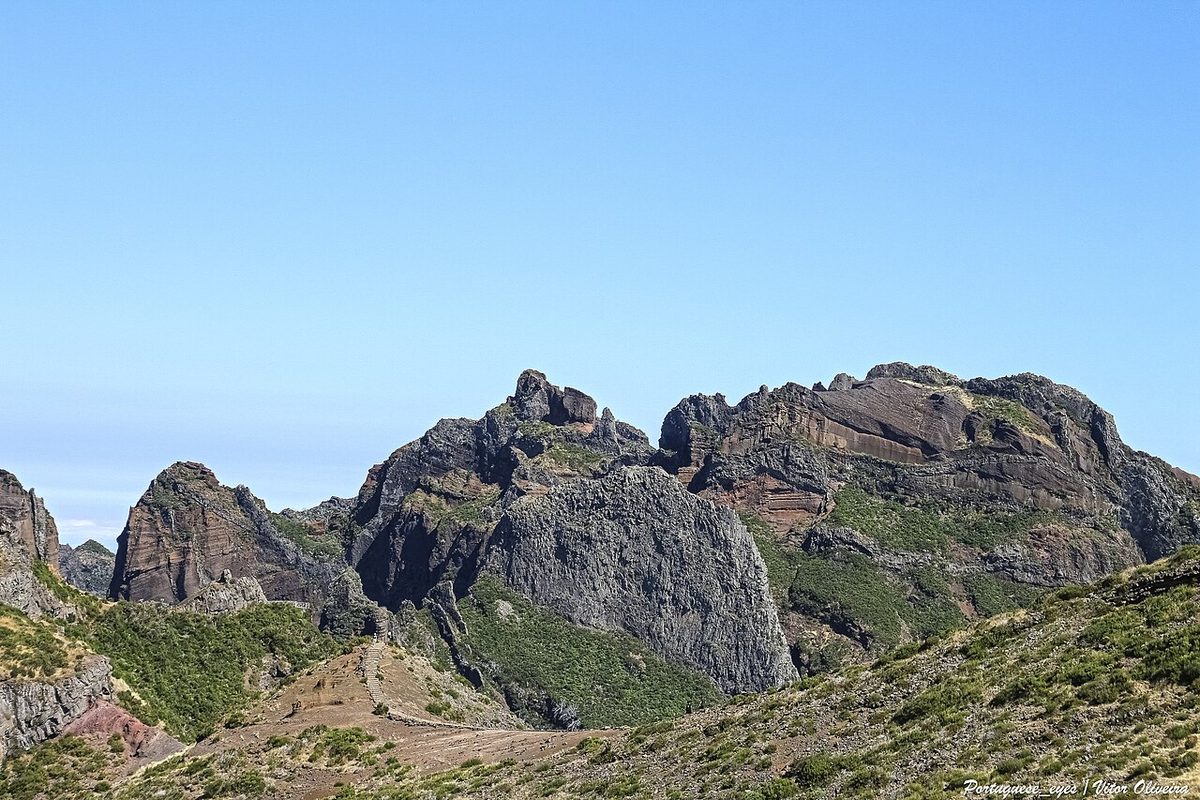
Madeira is one island, roughly 57 kilometres long, that rises to 1,862 metres about 600 kilometres off the Moroccan coast. Everything is close in kilometres and far in minutes, because the roads climb. A hire car is close to essential; the alternative is a series of transfers, which works but costs more over a week.
| Day | Base | Plan | Notes |
|---|---|---|---|
| 1 | Funchal | Arrive; the old town, the market, the cable car up to Monte and the wicker toboggan down | Flight from Lisbon ~1h45 |
| 2 | Funchal | Botanical garden or Monte Palace; a Madeira wine lodge tasting; the seafront in the evening | Walking and cable cars |
| 3 | East | Pico do Arieiro to Pico Ruivo along the ridge — the PR1 — booked in advance | Reservation required; see below |
| 4 | East | Ponta de São Lourenço, the bare volcanic peninsula at the island’s eastern tip; Machico or Caniçal | Car; exposed and hot in summer |
| 5 | North | Cross to Santana and the triangular thatched houses; the Ribeiro Frio levada; São Vicente | Car; the north is wetter |
| 6 | West | Porto Moniz natural volcanic pools; the Fajã dos Padres cable car; Paul da Serra plateau | Car; cloud on the plateau is normal |
| 7 | Funchal | A levada walk close to the city, or the beach at Calheta; fly out | Reservation required for the levada |
The reservation system you must know about. Madeira’s official walking trails now require a paid booking through simplifica.madeira.gov.pt, with 30-minute entry slots. It costs €4.50 per person per trail, except PR1 — the Pico do Arieiro to Pico Ruivo ridge — at €10.50. Three-day passes are €22.50 and seven-day passes €52.50. Under-12s are free but must be named on the booking; residents and people with a certified disability of 60 per cent or more are exempt; tour operators pay a lower rate of around €3 (simplifica.madeira.gov.pt, checked September 2026). Popular slots on PR1 sell out, so book this before you book anything else.
When to go: any month. Funchal averages a daily maximum of 20.0 °C in January and 26.8 °C in August. April to June is best for flowers and clear mountain days; September and October for the warmest sea. New Year in Funchal is enormous and books out a year ahead.
The Azores in seven days: São Miguel
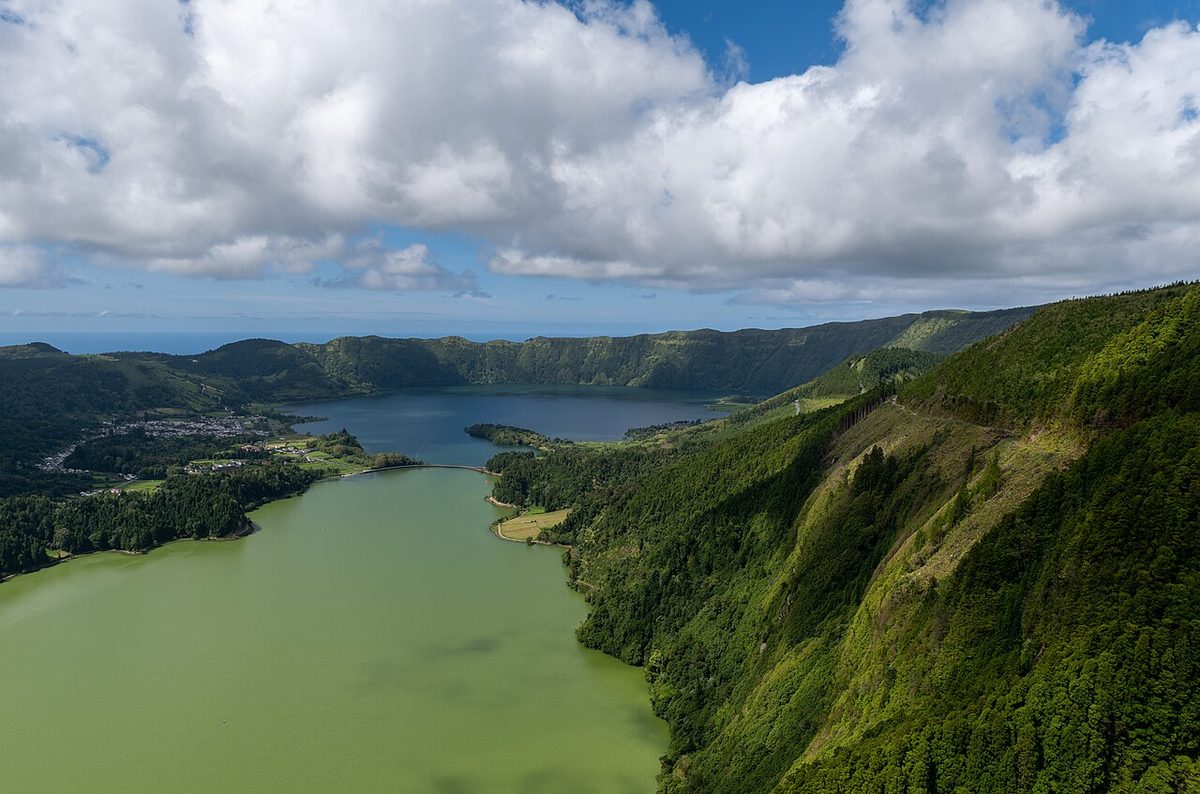
The Azores are nine islands spread across 600 kilometres of the mid-Atlantic. On a first visit, and certainly on a week, do one island. São Miguel is the largest, has the most varied landscape and the best connections, and is the right answer for almost everyone.
| Day | Base | Plan | Notes |
|---|---|---|---|
| 1 | Ponta Delgada | Arrive; the town, the black-and-white church fronts, the harbour | Flight from Lisbon ~2h25 |
| 2 | West | Sete Cidades: the twin green and blue lakes in a caldera, Vista do Rei and the Boca do Inferno viewpoint | Car; go early, cloud builds |
| 3 | Ponta Delgada | Whale watching — sperm whales resident year-round, dolphins year-round, the giants April to June | Boats from Ponta Delgada or Vila Franca |
| 4 | Furnas | The caldera village: fumaroles, the cozido cooked underground in volcanic steam, Terra Nostra’s iron-rich thermal pool | ~1h from Ponta Delgada |
| 5 | North-east | Nordeste and the eastern viewpoints; the tea plantations at Gorreana, the only tea grown in Europe | Car; slow winding roads |
| 6 | South | Vila Franca do Campo and its offshore crater islet; Lagoa do Fogo on a clear afternoon | Islet access is capped daily in summer |
| 7 | Ponta Delgada | Ponta da Ferraria, where a hot spring meets the sea in a tidal pool; fly out | Time it with low tide |
The whale calendar, precisely. Sperm whales are resident and recorded in every month of the year, and dolphins are year-round. Blue, fin and sei whales pass on migration roughly April to June, strongest from mid-April to mid-May, with most blue whales gone north by late June. So the best whale month and the best weather month are not the same month, and you have to pick.
If you have ten days in the Azores, add Pico — whose 2,351-metre volcano is the highest point in Portugal, and whose Lajes was a whaling port until 1984 — and Faial, twenty minutes away by ferry. Inter-island travel is by SATA Azores Airlines and the Atlânticoline ferries, and the summer ferry network is far denser than the winter one.
Itinerary variants for particular trips
If you are not driving
The corridor works entirely by train, and so does the Algarve coast. What is genuinely hard without a car: the Alentejo beyond Évora, the monastery triangle, Óbidos and Nazaré as a pair, the Costa Vicentina, Peneda-Gerês, and most of Madeira and the Azores away from the main towns.
The workaround for the mainland gaps is a day tour from Lisbon or Porto, which is more expensive per day than a hire car and cheaper than hiring a car for a week to use twice. For the islands, a week of transfers costs meaningfully more than a week of car hire, so if you are going to drive anywhere in Portugal, drive there.
With children
Two adjustments make an enormous difference. First, cut the number of bases: three bases in ten days rather than five, because packing and unpacking is where family trips lose their temper. Second, put something physical in every day — a tram, a boat, a cable car, a beach — rather than stacking monuments.
A ten-day family version: four nights in Lisbon (trams, the Oceanário, Belém’s boats and pastries, one Sintra day), then three in the eastern Algarve at Tavira or Cabanas for the warm shallow lagoon beaches and the ferry to the sandbar islands, then three back in Lisbon or straight home from Faro. It covers less and works far better.
In winter
A December-to-February itinerary should drop the Algarve beaches and either stay in the cities or go to Madeira. Lisbon and Porto are excellent winter city breaks at a third of the summer price. The Algarve is excellent for walking the coast path and useless for swimming. The Azores are wet and windy enough that inter-island flights cancel. Madeira is the reliable answer, and the reason its hotels fill with northern Europeans in January.
For food and wine
A seven-day version built around what is on the table: two nights in Porto for francesinha, tripas and the Gaia lodges; two in the Douro at a quinta, ideally during the September vindima; one in Coimbra or Aveiro; two in Lisbon for the tascas, the markets and a fado dinner. Add the Alentejo instead of Coimbra if reds matter more to you than whites — it is the country’s most serious red-wine region and its food is the heaviest and best in Portugal.
For surfing
Portugal has one of the most consistent surf coasts in Europe and it runs almost the whole western seaboard. A ten-day surf route: three nights at Ericeira, a World Surfing Reserve with several breaks inside a few kilometres; two at Peniche and Baleal; two at Nazaré if you are there between October and March and want to watch rather than paddle out; and three on the Costa Vicentina at Sagres or Aljezur. The water is cold on all of it — a wetsuit is not optional, even in August, because of the summer upwelling along this coast.
On a second visit
Skip both big cities and take the parts that ten-day itineraries always cut: the Alentejo from Évora down to the coast at Vila Nova de Milfontes, the interior Historic Villages along the old Spanish border, Peneda-Gerês in the far north, and the Serra da Estrela. It is the cheapest and emptiest version of Portugal and it needs a car.
Where to sleep on each route
Base choice does more for an itinerary than attraction choice, because it decides how much of each day you spend in transit.
| Stop | Stay in | Why | Avoid |
|---|---|---|---|
| Lisbon | Chiado, or Príncipe Real | Central and walkable without Baixa’s noise or Alfama’s steps | Anywhere reached only by an eighty-step staircase |
| Porto | Baixa around Aliados and Clérigos | Central, metro-connected, an easy walk down to the river | Ribeira itself, unless you like carrying luggage uphill |
| Douro valley | Pinhão or a quinta near it | On the river, in the best stretch of terraces | Régua, which is the transport hub rather than the scenery |
| Central Portugal | Óbidos inside the walls, or Nazaré | Both within an hour of the monastery triangle | Motorway hotels between them |
| Alentejo | Évora, or Monsaraz for one night | Évora is the base; Monsaraz is the view and the dark sky | Big roadside estates far from a town |
| Algarve | Lagos or Carvoeiro for cliffs; Tavira for the lagoon | Walkable towns with the right coast attached | The Albufeira strip, unless that is the point |
| Madeira | Funchal for five nights, one night in the north | Everything is a day trip from Funchal; the north is a different climate | Splitting the week across four hotels |
| São Miguel | Ponta Delgada, plus one night in Furnas | Furnas at night, with the thermal pools empty, is the best part | Trying to cover the island from one end |
What each itinerary costs
Rough per-person costs excluding international flights, based on prices checked in September 2026 and excluding August.
| Itinerary | Lean | Comfortable | Main variables |
|---|---|---|---|
| 5 days, two cities, train | €350–€450 | €700–€900 | Accommodation; the Alfa fare if not booked early |
| 7 days, the corridor | €500–€650 | €1,000–€1,300 | Sintra tickets, one port lodge, the Douro train |
| 10 days, corridor plus centre | €750–€950 | €1,400–€1,900 | Two days of car hire, monastery entries at €6–€10 each |
| 14 days, whole mainland | €1,050–€1,350 | €2,000–€2,700 | Car hire at €180–€300 a week plus tolls and one-way fees |
| 7 days, Madeira | €600–€800 | €1,200–€1,600 | Internal flight, car hire, trail permits |
| 7 days, São Miguel | €650–€850 | €1,300–€1,700 | Internal flight, car hire, one whale-watching trip |
The underlying daily figures: a budget day runs €70–€90 per person, and a comfortable day for two €150–€200 outside August. Meals are the reliable part — a prato do dia with wine is €9–€15 and a mid-range dinner for two €40–€60 almost anywhere in the country. Accommodation is what swings, and it roughly doubles in August.
What each day on these routes actually involves
The tables above give the shape. This is the detail — what a day at each stop consists of, how long each piece takes, and the practical trap in each one.
A Lisbon day, done properly
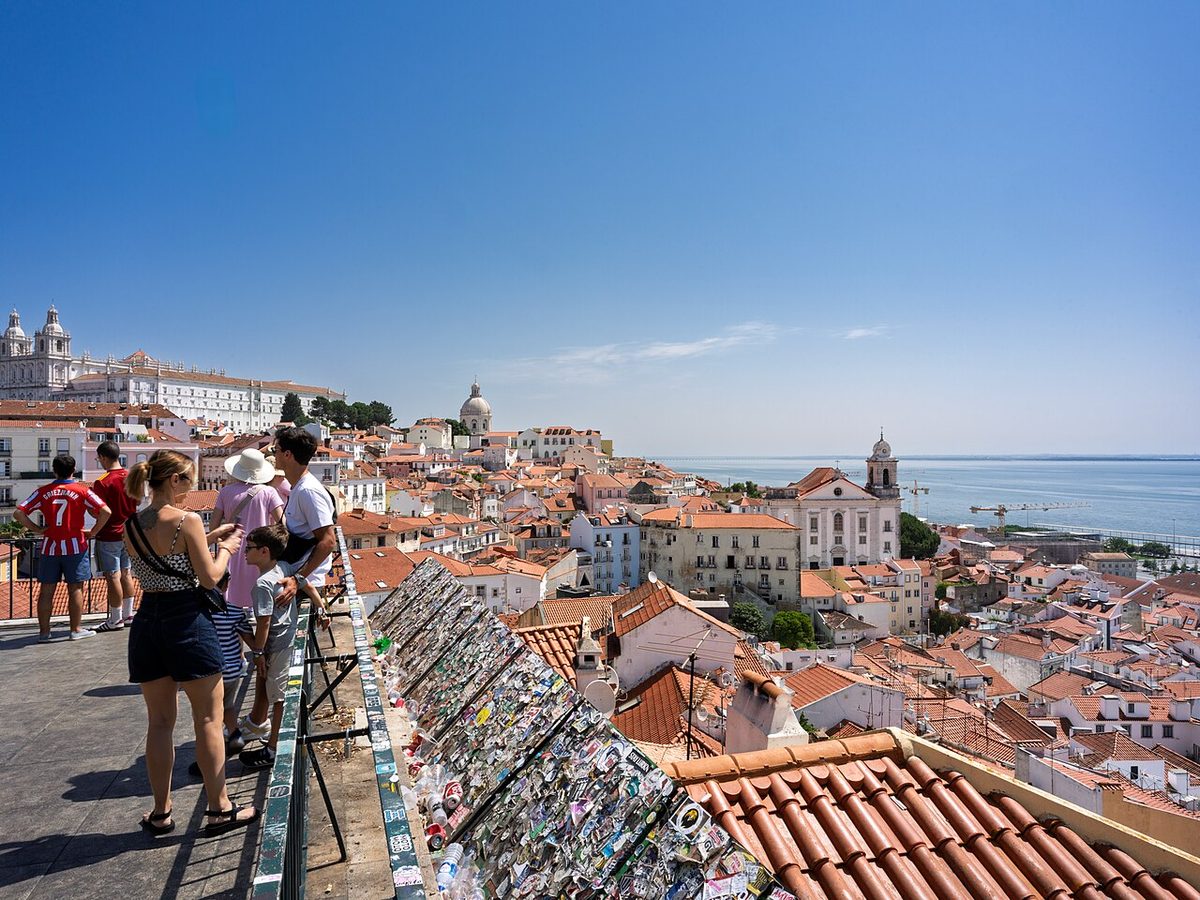
Lisbon rewards early starts more than any European capital I know, because the coach groups reach the Alfama viewpoints and the Belém monastery gates at almost exactly the same hour each morning. The city day that works: be at Largo das Portas do Sol before 09:30, drop downhill through Alfama on whatever alley looks least promising, and come out at the river two hours later. Then the Baixa grid, the Arco da Rua Augusta and the marble steps of the Cais das Colunas, which is the sequence the eighteenth-century architects intended.
Afternoon is for the hill: Chiado, the roofless Carmo Convent whose vault came down in the 1755 earthquake, and the climb up to Príncipe Real. Evening is fado, in a small room in Alfama or Mouraria that charges a minimum consumption rather than a fixed menu, after 21:30.
The trap: tram 28 between 10:00 and 16:00, where you queue forty minutes at Martim Moniz to stand pressed against a stranger while a pickpocket works the carriage. Board at the Campo de Ourique end instead, or take tram 12 over much of the same ground. Our Lisbon guide has the full district-by-district version.
A Belém half day
Six kilometres west of the centre, reachable by tram 15E in about half an hour or by train from Cais do Sodré more quickly. The single most useful piece of advice is about timing: be at the Jerónimos Monastery when it opens and you will have the Manueline cloister almost to yourself for twenty minutes; arrive at noon and you will queue for an hour to shuffle round it.
The cloister is the thing to see. The church next door, where Vasco da Gama is entombed, is free and takes ten minutes. The Torre de Belém is beautiful from the outside and a cramped, traffic-lighted spiral staircase on the inside — photograph it, skip the interior. Then Pastéis de Belém, which has been making the recipe on site since 1837, and where the sit-down rooms at the back move much faster than the takeaway queue on the street.
Add one museum, not four. The Coach Museum holds the best collection of state carriages anywhere; MAAT is a low white wave on the river with a free rooftop walk; the Ajuda Palace up the hill is the most underrated interior in Lisbon and is usually empty.
A Sintra day
Forty minutes from Rossio by train, and the most mismanaged crowd situation in Portugal. Two things will decide whether it works.
First, the ticket. Pena Palace entry is timed to a date and slot, and the official Parques de Sintra pricing lists an “Essential Visit” to the palace at €20, a “Complete Visit” covering palace and park at €45, and park-only entry at €12. A great many resellers still quote an older structure of €20 combined and €10 park-only. Those are materially different trips for materially different money, so buy from parquesdesintra.pt and treat third-party prices as out of date until proved otherwise (checked September 2026). The park runs 09:00–19:00 with last admission at 18:00; the palace 09:30–18:30 with last ticket at 17:30.
Second, the hill. The 434 bus queue routinely runs 30–40 minutes between 10:00 and 13:00 in summer. The Vila Sassetti footpath climbs the same hill through gardens in about 35 minutes and is the better option for anyone who can manage a steady uphill walk.
Pick two things, not four. Pena and Quinta da Regaleira, with its inverted initiation well, is the standard pairing and is enough. The Moorish castle walls, the National Palace in the town and Monserrate are all good and all cost you another hour of bus queue each.
A Porto day
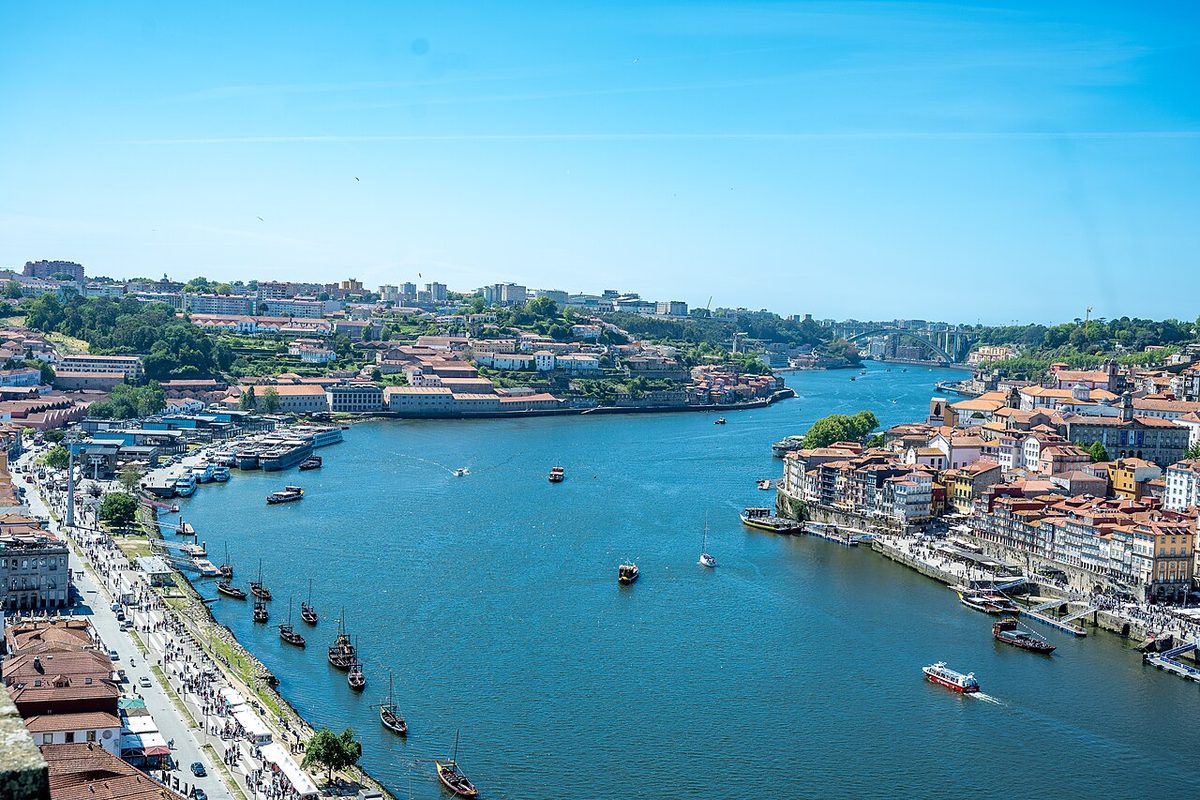
Start at São Bento station at 08:30, when its 20,000 azulejos are lit by the west windows and the hall is empty. Then the Baixa hill: the Clérigos tower and its 240 steps, the Livraria Lello, the tiled fronts of the Capela das Almas and Santo Ildefonso, and the Bolhão market while the produce side is still trading.
Downhill in the afternoon through the Palácio da Bolsa — whose Arabian Hall is guided-tour only and genuinely dazzling — to the Igreja de São Francisco, a plain Gothic shell whose interior was later covered in something like 300 kilograms of gilded carving. Then the Ribeira, and the upper deck of the Dom Luís I bridge at sunset, which is the best free thing in the city.
The Lello caveat: the entry voucher is redeemable against a book, and the prices are quoted inconsistently by different sellers — some list €8 and €16 for the two tiers, others €10 and €15.95. Check the shop’s own site on the day. The walk-up queue runs 30–60 minutes from April to October (checked September 2026).
A Gaia and port day
Every port house in the world ages its wine on the Gaia bank, in long low lodges with the brand names painted on the roofs — a trade practice going back to the eighteenth century, when the cooler riverside cellars were found to age the wine better than the hot valley where the grapes grow.
A standard guided tour with two or three tastings runs €20–€30 (checked September 2026). Book one, for a specific time, ideally the last of the afternoon so that you finish on a terrace looking back at Porto in the evening light. Do not do three: the tours cover the same ground and you will have had six to nine glasses of a 20 per cent wine before dinner.
Fill the rest of the day with the Serra do Pilar monastery and its genuinely circular cloister, the cable car down at about €7 one way, and the Jardim do Morro at sunset. Our Porto guide covers which lodge to choose and what the styles actually mean.
A Douro day
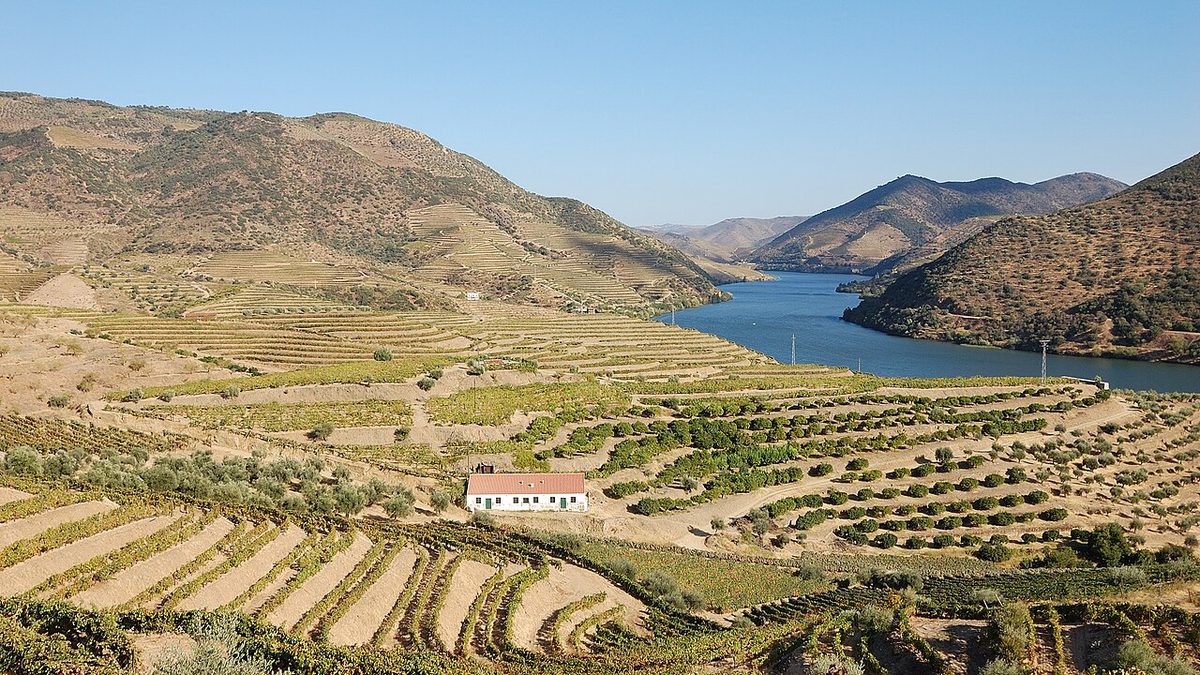
The Linha do Douro leaves São Bento and follows the river east into the Alto Douro, demarcated in 1756 and the oldest protected wine region in the world. Porto to Pinhão takes about 2h20 and costs around €12.45 one way, and there are only about two direct regional services a day, at roughly 09:25 and 13:25 (cp.pt, checked September 2026). Take the earlier one, and sit on the right-hand side leaving Porto.
At Pinhão, the station itself is tiled with panels showing the harvest, and the quintas within walking distance of it will take a booking for a tasting. Traditional rabelo boats run short trips on the river. If you are there in September, the vindima is under way and some estates let visitors tread.
The alternative to avoid: the full-day coach-and-cruise package, which puts you on a bus for two hours each way, on a boat for one hour of a short stretch, and in one quinta — for several times the cost of the train.
A Coimbra day
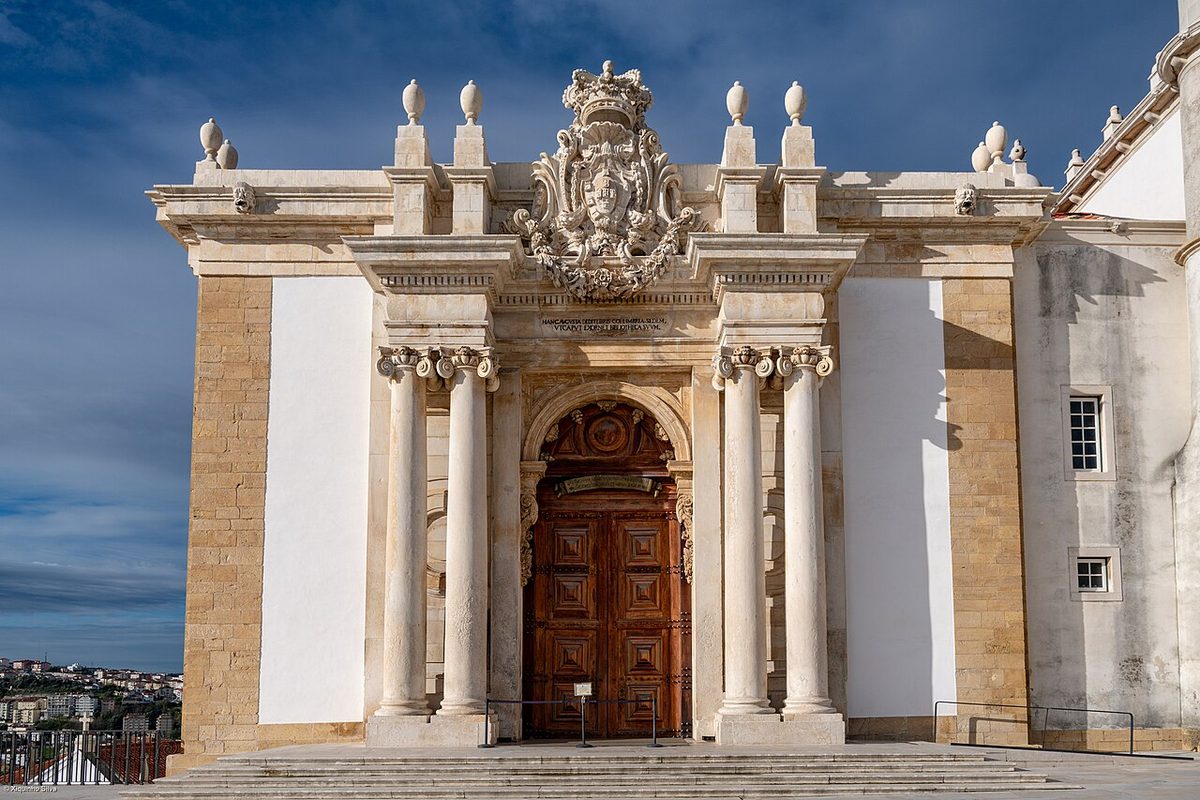
The university was founded in 1290 and its old buildings sit on the hilltop above the river. The Joanina library is the reason to come: three barrel-vaulted rooms of gilded wood and 60,000 volumes, kept at a stable humidity by two-metre walls and protected from insects by a resident colony of bats that emerges at night to eat them. Entry is timed and the visit is short.
Below it, the old town is a steep tangle of student housing, and Coimbra has its own distinct fado — sung by men, historically by students, in a different register from the Lisbon version, and performed with the audience coughing rather than clapping in appreciation. The Roman town of Conimbriga, with the best mosaics in Portugal, is fifteen kilometres away.
An Óbidos and Nazaré day
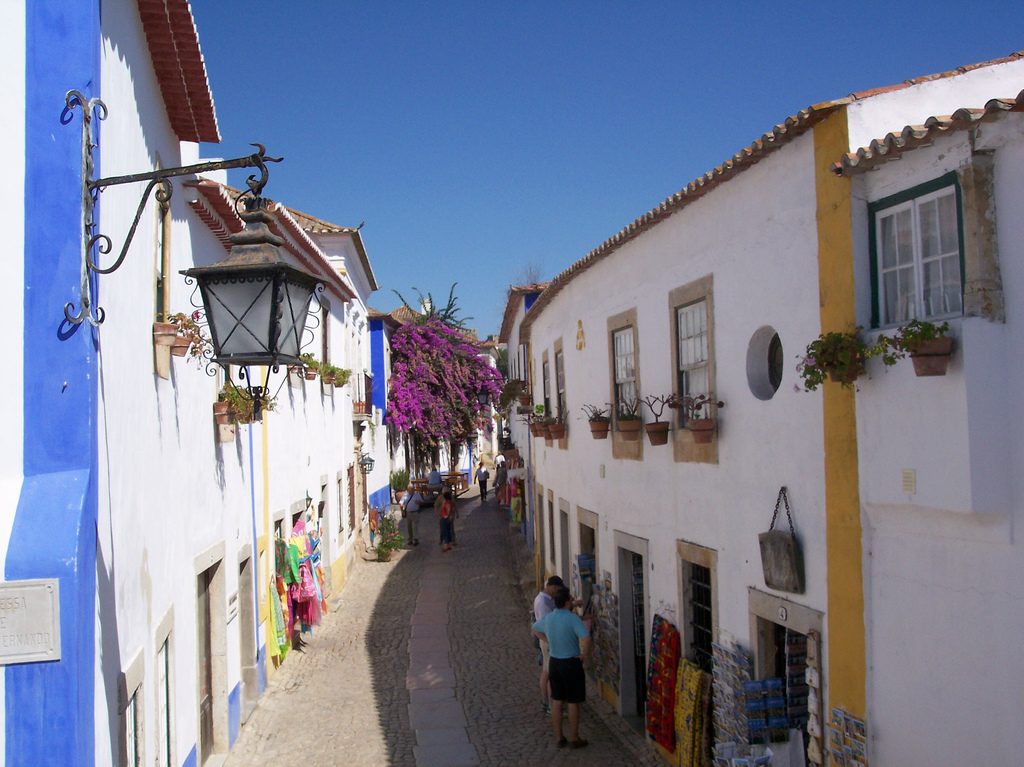
Óbidos is a complete walled medieval town about an hour north of Lisbon, given as a wedding present to Portuguese queens for four centuries. It is genuinely lovely at 09:00 and comprehensively overrun by 11:00, when the coaches arrive. You can walk the top of the walls, which have no handrail on the drop side and are not for anybody uneasy with heights. Ginja served in a chocolate cup is the local ritual.
Nazaré, half an hour further, is a fishing town with a funicular up to the Sítio headland and the lighthouse fort above Praia do Norte. The big-wave season runs roughly October to March, biggest between November and February, when North Atlantic storms funnel swell up an underwater canyon that runs almost to the beach. In summer Praia do Norte is an ordinary beach and the fort is a museum of photographs of waves that are not there.
A monastery triangle day
Alcobaça, Batalha and Tomar sit within an hour of each other and hold three UNESCO World Heritage sites. Entry runs €6–€10 each (checked September 2026), and doing all three in one day is possible and slightly indigestible; two is better.
Alcobaça is the largest church in Portugal, Cistercian and severe, and holds the tombs of Pedro and Inês placed foot to foot. Batalha is late Gothic at its most elaborate, with the Unfinished Chapels — an octagonal mausoleum whose vault was never built, left open to the sky since the sixteenth century. Tomar’s Convent of Christ was the Portuguese headquarters of the Knights Templar; the round church at its heart is modelled on the Holy Sepulchre, and the Manueline window on its west front is the single most reproduced piece of carving in the country.
An Évora day
An hour and a half east of Lisbon, Évora is a walled Alentejo town with a Roman temple standing in the middle of it, a cathedral you can climb for a view over the plain, and the Capela dos Ossos — a chapel lined with the bones of about 5,000 people, with an inscription at the door telling visitors that the bones inside are waiting for theirs.
The rest of the day is food and wine. The Alentejo is Portugal’s most serious red-wine region and its cooking is the heaviest and best in the country: bread soups, black pork, lamb stews, and sheep’s cheese. Lunch here costs a fraction of Lisbon prices.
If you are staying the night, drive on to Monsaraz, a tiny walled village on a hill above the Alqueva — the largest artificial lake in western Europe and the world’s first certified Starlight Tourism Destination. The night sky there is the darkest you will see in western Europe.
An Algarve day
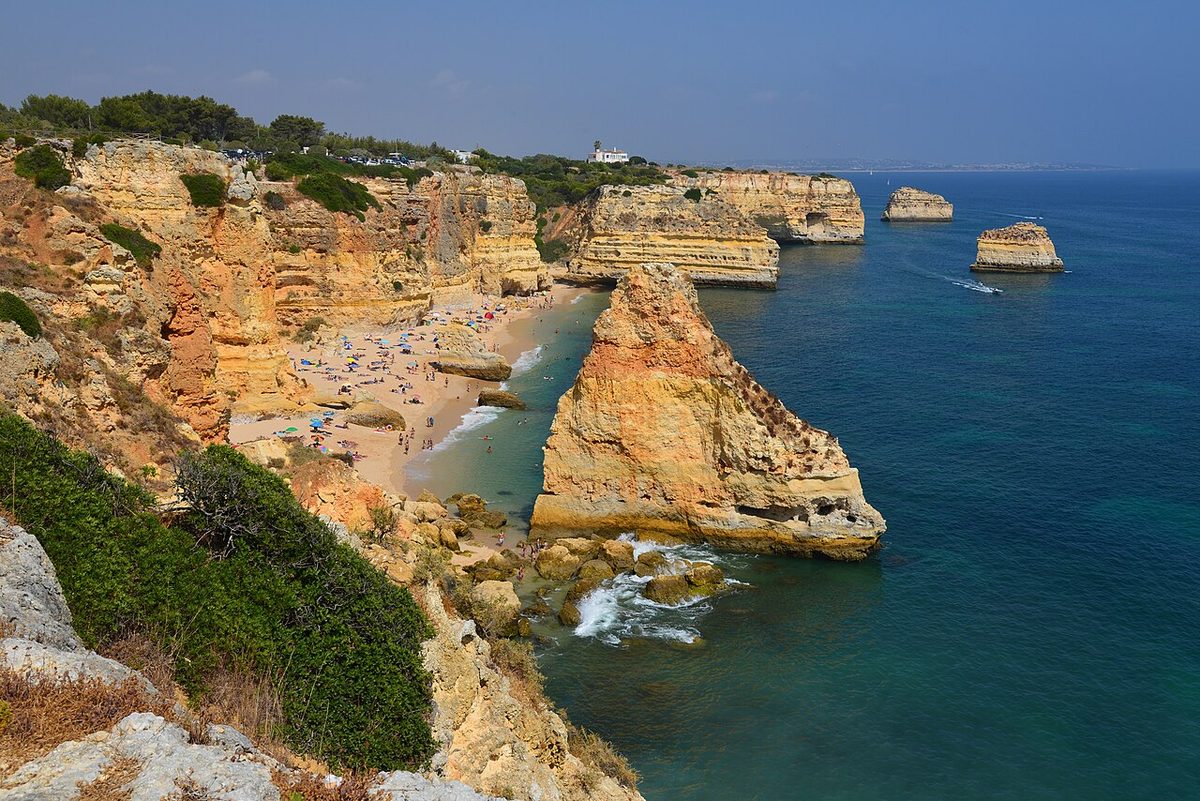
The best single thing you can buy on this coast is a small-boat trip along the limestone cliffs between Portimão and Albufeira. Take a rigid inflatable holding eight to twelve people, not a catamaran holding eighty — the large boats cannot enter the caves, which is the point of the trip. Guided kayak trips run about €30–€40 a head (checked September 2026) and get closer still.
The Benagil rules have changed and most guides have not caught up. Under the Maritime Authority’s Edital 019/2024 as amended by 009/2025, swimming to the cave is banned with or without a float, landing on the sand inside is banned, and self-guided kayak or paddleboard rentals may not enter, though your own craft with a lifejacket is permitted. Motorised boats stay about fifteen metres off and enter by the western arch; non-motorised craft use the eastern. Groups get five to ten minutes inside (checked September 2026).
The other half of an Algarve day is the Seven Hanging Valleys coast path, about six kilometres of clifftop between Praia da Marinha and Praia de Vale Centeanes. There is no shade, so walk it early. Our Algarve guide covers the three coasts and which beach suits which trip.
The day-trip menu
If your itinerary is two or three bases rather than a moving route, these are the days out that each base supports.
| From | Destination | Getting there | Verdict |
|---|---|---|---|
| Lisbon | Sintra | Train from Rossio, ~40 min | The single most searched excursion in Portugal; book Pena ahead |
| Lisbon | Cascais | Train from Cais do Sodré, ~40 min | The lowest-effort good day out; bike to Guincho |
| Lisbon | Setúbal & Arrábida | Ferry plus bus, or car, ~1h15 | Resident dolphins, white-sand coves, cheap fish; nobody goes |
| Lisbon | Évora | Bus or train, ~1h30 | Worth an overnight rather than a day |
| Lisbon | Óbidos | Bus, ~1h | Charming; overrun by 11:00 |
| Porto | Douro valley | Train, ~2h20, ~€12.45 | The best day trip in Portugal |
| Porto | Guimarães | Train, ~1h10 | Where Portugal was founded; genuinely lovely |
| Porto | Braga | Train, ~1h | Best at Easter; otherwise pair with Guimarães |
| Porto | Passadiços do Paiva & 516 Arouca | Car or transfer, ~1h | €12 combined, online only, daily cap; the best active day out |
| Algarve | Ilha de Tavira or Culatra | Small ferry | The best beach day on the coast |
| Algarve | Cape St Vincent | Car, from Lagos ~1h | Go for sunset; take a jacket even in August |
| Algarve | Monchique and Fóia | Car, ~45 min from the coast | 902 m, and ten degrees cooler in a heatwave |
Two-base itineraries, for people who hate packing
If moving hotel every second night sounds like a chore rather than an adventure, the two-base structure gives you most of the country with a fraction of the logistics. Each of these works on a week and stretches comfortably to ten days.
Lisbon and the Algarve
Four nights in the capital and four on the south coast, connected by a three-hour drive or a train to Lagos. The capital gives you the city, Belém and Sintra; the Algarve gives you the cliffs, one boat trip and a coast walk. It is the most popular shape of Portuguese holiday and there is nothing wrong with it, beyond the fact that it misses the north entirely.
Make it better by: basing in the eastern Algarve at Tavira rather than the central resorts, and taking the ferry to a sandbar island for at least one day. The eastern lagoon has the warmest water in mainland Portugal and about a tenth of the crowding.
Porto and the north
Four nights in Porto and three or four in the Douro or the Minho. From Porto you can reach Guimarães, Braga, Aveiro and the Paiva walkways as day trips without moving hotel, and the Douro deserves its own base for two nights if you want to visit quintas properly rather than pass through Pinhão between trains.
Make it better by: adding Peneda-Gerês if you have a car. Portugal’s only national park is ninety minutes from Porto and effectively unvisited by international tourists.
Lisbon and the Alentejo
The version almost nobody books and the one experienced visitors keep recommending. Four nights in Lisbon, three or four in Évora and around it: wine estates, walled hill towns, megalithic stone circles older than Stonehenge, the Alqueva dark sky, and the Alentejo coast at Vila Nova de Milfontes, which is what the Algarve looked like in 1975.
Make it better by: going in April or October. The Alentejo in high summer regularly exceeds 40 °C and the landscape is burnt brown; in spring it is green and full of wildflowers.
How the itineraries change by season
The same route is a different trip in February and in August, and two of the four routes above should simply not be attempted in certain months.
| Season | What works | What to change |
|---|---|---|
| December–February | The corridor; Madeira; the Algarve on foot | Cut all beach days; add indoor time in Porto, which is genuinely wet; skip the Azores |
| March–April | Everything except swimming | The best months for the coast paths and the Alentejo; Easter spikes prices and fills Braga |
| May–June | Every route on this page | Book around Santo António in Lisbon on 12–13 June and São João in Porto on 23–24 June |
| July–August | The coast and the north; the Azores | Cut Évora and the interior, where daily maxima average above 33 °C; start every day at 08:00 |
| September | Every route, at its best | Add the Douro for the vindima; the sea is at its annual warmest |
| October–November | The corridor, the Algarve, Madeira | Beach businesses start closing; Nazaré’s big-wave season begins |
Two dates are worth building an itinerary around or deliberately avoiding: Santo António in Lisbon on the night of 12–13 June, and São João in Porto on the night of 23–24 June. Both fill their cities completely and both are among the best street parties in Europe. Our month-by-month guide to when to visit has the full climate data behind this table.
Adding Spain, or a third week
Portugal and Spain together
Three combinations work without wasting days. Seville sits about two and a half hours by road from Faro across the Guadiana — remember that Spain is an hour ahead, which catches people out on day trips in both directions. Salamanca and the Spanish interior are within reach of Porto and the Douro. Santiago de Compostela is about two and a half hours north of Porto and pairs naturally with the Minho.
The one to avoid: Madrid, which is a long way from anywhere in Portugal and turns a two-country trip into a transport exercise. If Madrid is on the list, fly between the two rather than driving.
A three-week Portugal itinerary
Twenty-one days is enough to do the mainland without hurrying and to add one island group properly. The shape that works:
| Week | Where | Plan |
|---|---|---|
| One | North | Porto for three nights, the Douro for two, Guimarães and Braga or Peneda-Gerês for two |
| Two | Centre and south | Coimbra, the monastery triangle, Óbidos and Nazaré, then Lisbon for three nights with Sintra |
| Three | Alentejo and Algarve, or an island | Either Évora and the south coast, or fly to Madeira or São Miguel for the last seven days |
At three weeks the calculation changes in one useful way: a hire car for the middle week only becomes clearly the right answer, because the first and third weeks are city-and-island time where a car is a liability.
What to skip: the overrated stops and the mistakes that spoil good itineraries
None of what follows is bad. All of it costs an itinerary more than it returns.
Trying to fit the Algarve into ten days
The commonest single error. From Lisbon the Algarve is a three-hour transfer each way, and a ten-day trip that includes Porto, Lisbon and the Algarve gives you roughly a day and a half on the south coast for six hours of driving. Either give the Algarve four nights or leave it for another trip.
Five bases in ten days
Every change of hotel costs you a morning and an evening — packing, checking out, transferring, checking in, finding dinner in an unfamiliar place. Three bases in ten days is comfortable, four is busy, five is a logistics exercise with sightseeing attached.
Hiring a car for the whole trip
If your itinerary includes three nights in Lisbon and three in Porto, six of your rental days are spent paying for parking in cities where the car cannot go where you want to be. Hire it for the middle section only.
Booking Sintra as a four-stop coach tour
The standard full-day tour does Pena, Sintra town, Cabo da Roca and Cascais — four places in eight hours with three transfers, delivering about ninety minutes at Pena, which is the only one of the four that needs three hours. Take the train and pick two things.
The full-day Douro coach and cruise
Two hours on a bus each way, an hour on a boat on a short stretch of river, a lunch and one quinta, for several times the cost of a €12.45 train ticket that runs closer to the water than the road does.
Aveiro as “the Venice of Portugal”
Aveiro is a pleasant small city with three short canals, good art nouveau frontages and excellent egg-based sweets. The Venice comparison sets an expectation it cannot meet. Go for the striped fishermen’s houses at Costa Nova and the hand-worked salt pans, not for the canals.
Cabo da Roca as a destination
The westernmost point of continental Europe is a cliff, a car park, a monument and a shop selling certificates for about €12. The cliff is genuinely fine and the detour is twenty minutes from Sintra or Cascais. It is not a reason to restructure a day.
Assuming the west coast is a swimming coast
The Atlantic from Sagres north is cold, rough and rip-prone, because summer northerlies push surface water offshore and cold water rises to replace it. People arrive expecting the sea they had in Albufeira. Wetsuit weather in August, and genuinely dangerous for casual swimmers.
Underestimating the hills
Both big cities are built on steep ground with polished limestone or granite paving that is slick in the rain. A hotel “500 m from the castle” that is also 60 m below it is a daily climb, not a stroll. Check the contour lines before booking, and plan routes that go downhill towards the water.
How to build your own itinerary in six steps
If none of the routes above fits your dates, this is the order to make the decisions in. Doing them in this sequence prevents the two failure modes: a route that cannot physically be driven, and a route that spends its budget on transfers.
One: count your real days. Subtract the arrival and departure days, or at least count them as halves. A “ten-day trip” is usually eight usable days.
Two: pick the shape. Corridor, full sweep, two bases, or mainland plus island. This decision constrains everything after it and is the one people skip.
Three: fix the anchors. Choose the two or three places you would be disappointed to miss, and build outwards. Most itineraries fail because they were assembled from a list of everything rather than around a small number of things that actually matter to the traveller.
Four: apply the two-night rule. No stop gets one night unless it is genuinely a waypoint. One night means arriving in the late afternoon and leaving after breakfast, which is not a visit.
Five: decide the transport per leg, not per trip. The Lisbon–Porto leg is a train. The Alentejo is a car. The Douro is a train. The Algarve coast is either. Mixing is normal and usually cheaper than committing to one mode.
Six: check the dates against the calendar. Santo António, São João, Easter, August and the New Year in Funchal all change availability and price dramatically. So does the Douro harvest, in a good way.
A booking order that saves money and stress
The sequence matters, because some things sell out months ahead and others are cheapest at the last minute.
Book first, as soon as your dates are fixed: accommodation for any stay covering Santo António, São João, Easter, August or New Year in Madeira. Madeira’s PR1 trail permit if the ridge walk matters to you — the popular slots go early. Any quinta stay in the Douro during the September harvest.
Book about two months ahead: the Alfa Pendular, where promotional fares from around €16 are released up to sixty days out, are non-refundable and sell out (cp.pt, checked September 2026). Hire cars, which rise steadily as availability tightens. Pena Palace timed slots for summer weekends.
Book two to four weeks ahead: port lodge tours in English at the larger Gaia houses, which fill at weekends and in summer. The Passadiços do Paiva and 516 Arouca combined ticket at €12, which is online only with a daily cap and no on-site sales. Popular restaurants in Lisbon and Porto.
Leave until you are there: Algarve boat trips, which depend on the sea state and are easy to book a day ahead; most museum entries outside Sintra and Lello; day trips from either city; and anything weather-dependent in the Azores, where the forecast three days out is more useful than a booking three weeks out.
Practical basics that shape an itinerary
Entry rules and the EES
The EU Entry/Exit System began a phased rollout on 12 October 2025 and reached full operation on 10 April 2026, which means biometric registration at the border for non-EU travellers. ETIAS is a separate scheme and is expected in the last quarter of 2026, with the exact date to be announced at least six months in advance. Allow extra time at the border on arrival, particularly at Faro in summer, and check your own government’s travel advice rather than any commercial site advertising ETIAS applications.
Money and daily costs
Portugal uses the euro and cards are accepted almost everywhere, though small tascas, market stalls and some rural cafes still prefer cash. Expect a bica at the counter at €0.80–€1.20, a prato do dia with soup and a glass of wine at €9–€15, a mid-range dinner for two at €40–€60, and a bottle of vinho verde in a shop at about €10 (all checked September 2026).
The couvert — the bread, olives and small dishes that arrive unasked — costs €2–€5 and is not free. You may wave it away without offence. Tipping is modest: rounding up, or five to ten per cent after a good meal.
Opening hours and the rhythm of the day
Lunch is the main meal and the best cooking in most restaurants happens between 12:30 and 14:30. Dinner starts late by northern European standards — kitchens fill from 20:00 and a 19:00 booking marks you as a visitor. Many museums close on Mondays, and many smaller monuments close for lunch. Shops in small towns shut for a couple of hours in the middle of the day and much of Sunday.
Language
English is widely spoken in Lisbon, Porto, the Algarve and anywhere with a hotel, and much less so in the Alentejo interior and the smaller Azorean islands. Portuguese is not Spanish and attempting Spanish is a minor social error rather than a helpful shortcut — bom dia, obrigado if you are male and obrigada if you are female, and a conta, por favor will carry you a long way.
Safety
Portugal is among the safest countries in Europe and violent crime against visitors is rare. The realistic risks are three: pickpocketing on Lisbon’s tram 28, in the metro at rush hour and at crowded viewpoints; theft from parked cars at beach car parks and trailheads, so leave nothing visible including in the boot; and the physical hazards — undercut cliffs on the Algarve and at Nazaré, rip currents on the west coast, and polished stone pavements in the rain.
Connectivity and driving admin
Mobile coverage is good along the coast and in both cities, and patchy in the Monchique hills, the Serra da Estrela and parts of the Azores. Electronic tolls have no cash option on several motorways, so take the hire company’s transponder. And speed limits are enforced by camera on the main routes rather than by patrol, with fines following you home through the rental company.
The regions in brief: what each one is for
An itinerary is a sequence of regions, and knowing what each one actually delivers — and how many days it absorbs — is what stops a route from being a list of towns.
The Minho and the far north
Green, wet, and the birthplace of the country. Guimarães holds the castle and the ducal palace where the county that became Portugal was governed, and a wall in the old town reads “Aqui nasceu Portugal”. Braga is the religious capital, with the baroque zigzag stairway of Bom Jesus do Monte and a water-counterweight funicular running since 1882. Behind them, Peneda-Gerês is Portugal’s only national park: granite villages, Roman road markers, waterfalls with swimming holes and semi-wild ponies. Vinho verde comes from here.
Days needed: two as day trips from Porto, four if you want the national park properly. Best months: May, June and September. Car: essential for Gerês, unnecessary for the towns.
Porto and the Douro
The second city and the wine country behind it. Porto is compact, steep and dense; the Alto Douro, demarcated in 1756, is the oldest protected wine region in the world and the terraces above Pinhão are the landscape everyone photographs. The two are connected by the best train ride in Portugal.
Days needed: two for the city, one for the valley as a day trip, four if you sleep in the Douro. Best months: May, June and September for the harvest. Car: unnecessary unless you want the N222 road above the river.
Central Portugal
The most consistently skipped part of the country and the densest concentration of monuments in it. Coimbra’s university and its Joanina library; the three UNESCO monasteries at Alcobaça, Batalha and Tomar; walled Óbidos; Nazaré and its winter waves; Aveiro’s canals and the striped houses at Costa Nova. Inland, the Serra da Estrela rises to 1,993 metres and carries Portugal’s only ski runs, and the Historic Villages — twelve of them along the old Spanish border, including Monsanto, built around and under giant granite boulders — are among the strangest places in Europe.
Days needed: two for the monastery cluster and Óbidos, four to add the mountains and the border villages. Best months: April to June, September and October. Car: essential.
Lisbon and its day-trip belt
The capital plus the best set of excursions of any European city: Sintra’s palaces, Cascais and the Estoril coast, Mafra’s enormous baroque palace-convent, Arrábida’s white-sand coves and the resident dolphins of the Sado estuary, and Évora within reach for a long day.
Days needed: three for the city, four or five with day trips. Best months: March to June, September and October. Car: a liability in the city, useful for Arrábida.
The Alentejo
A third of the country’s land area and a fraction of its visitors. Cork oak, wheat, whitewashed villages, walled hill towns, Roman ruins, megalithic stone circles older than Stonehenge, and the best red wine and the heaviest food in Portugal. The Alqueva is the largest artificial lake in western Europe and the world’s first certified Starlight Tourism Destination. The coast at Vila Nova de Milfontes and Zambujeira do Mar is what the Algarve looked like fifty years ago.
Days needed: two minimum, four to do it justice. Best months: April, May and October — high summer regularly exceeds 40 °C. Car: essential.
The Algarve
Three coasts sharing an airport: a warm, flat lagoon and sandbar system in the east; the golden limestone cliffs and coves of the centre; and an exposed, cold, almost undeveloped Atlantic seaboard in the west. Behind them, a hilly interior of cork and orange that is ten degrees cooler in August and where the food stops being aimed at visitors.
Days needed: four for one coast, seven for two, ten for all three. Best months: May, June, September and October. Car: yes, unless you are basing in Lagos or Tavira and using the coastal train.
Madeira and the Azores
Madeira is one steep subtropical island 600 kilometres off Morocco, rising to 1,862 metres, with the mildest year-round climate in Europe and a network of levada water-channel walks that now require a paid permit. The Azores are nine volcanic islands in the mid-Atlantic with caldera lakes, hot springs, the highest mountain in Portugal at Pico’s 2,351 metres, and resident sperm whales.
Days needed: seven each, minimum. Best months: Madeira any month, April to June for flowers; the Azores July to September for weather, April to June for the migrating whales. Car: effectively essential on both.
Short trips: three and four days
Plenty of people arrive with less than five days, usually from elsewhere in Europe. The rule for a short Portugal trip is brutal and simple: one city, no transfers.
| Length | Route | Why |
|---|---|---|
| Long weekend, Lisbon | Two days in the city, one in Sintra | The city is enough on its own; Sintra is the one excursion that justifies a day |
| Long weekend, Porto | Two days in the city and Gaia, one on the Douro line | Porto is smaller and the Douro train is the best thing in the north |
| Four days, either city | Add a second day trip — Cascais or Setúbal from Lisbon, Guimarães from Porto | Still no hotel change |
| Four days, both cities | Two nights each, Alfa Pendular between | Fast but workable, because the train is only 2h39–2h50 |
The one thing not to do on a short trip is add the Algarve. Three hours each way out of four days leaves you a single afternoon on a beach.
Eating your way along the route
Portuguese food is regional in a way that is easy to miss if you order the same three dishes across the country. Each stop on these itineraries has something it does better than anywhere else, and following that is a legitimate way to structure a trip.
| Where | Order this | What it is |
|---|---|---|
| Porto | Tripas à moda do Porto | Tripe and white bean stew; the city’s own dish and its nickname |
| Porto | Francesinha | Layered meat sandwich under melted cheese in a beer-and-tomato sauce; share one first |
| Matosinhos | Whatever came in that morning | Charcoal-grilled fish on the pavement, €15–€25 a head |
| Douro | A 20-year tawny, and a dry Douro red | The unfortified reds from the same terraces are the region’s underrated half |
| Aveiro | Ovos moles | Sweetened egg yolk in a thin wafer shell, moulded into shells and fish |
| Coimbra | Leitão | Roast suckling pig, from the Bairrada country just north |
| Nazaré | Caldeirada | Fisherman’s stew of whatever the boats brought back |
| Lisbon | Bacalhau à Brás, and a bifana | Salt cod with shredded potato and egg; a marinated pork sandwich from a counter bar |
| Belém | Pastéis de Belém | The original custard tart, made on site since 1837, at €1.20–€1.50 |
| Alentejo | Porco preto and açorda | Black Iberian pork, and a garlic-and-coriander bread soup |
| Algarve | Cataplana, and polvo à lagareiro | Seafood stewed in a hinged copper pan; octopus roasted in olive oil |
| Madeira | Espetada and bolo do caco | Beef on a bay laurel skewer; garlic-buttered flatbread |
| Azores | Cozido das Furnas | A stew buried in volcanic ground and cooked for six hours by the earth |
Prices where quoted were checked in September 2026. Two rules apply everywhere: order the prato do dia at lunch in any place with a handwritten board, at €9–€15 with soup and wine; and walk one street back from any main tourist thoroughfare before choosing a restaurant, which reliably cuts the bill by a third and improves the cooking.
Accessibility and slower travel
Portugal’s two great cities are built on steep ground surfaced with polished limestone or granite setts, and a great many of its best sights are reached by stairs cut into a cliff. That is a real constraint and it is rarely mentioned in itineraries, so it is worth planning around rather than discovering.
What helps in Lisbon: the funiculars — Bica, Glória and Lavra — and the Santa Justa lift exist precisely to solve the gradient, and using them to gain height and then walking downhill turns the city from an ordeal into a pleasure. The metro is step-free at most stations. Belém and Parque das Nações are both flat.
What helps in Porto: the funicular dos Guindais between the Ribeira and the upper bridge deck, the Gaia cable car, and the metro. The lower deck of the bridge is level with the quaysides on both banks.
What to substitute: in the Algarve, the flat-access beaches — Meia Praia at Lagos, Praia de Alvor, Praia da Rocha, and the eastern lagoon beaches reached by ferry and boardwalk — rather than the cliff coves with their long wooden staircases. In Sintra, the 434 bus rather than the Vila Sassetti footpath, accepting the queue. On the islands, the coastal viewpoints and the levadas graded as easy rather than the ridge routes.
Slower travel is also simply a better way to see Portugal. The country rewards sitting in a square for an hour more than it rewards a fifth monument, and every itinerary on this page improves if you delete one stop from it.
How the route changes for solo travellers, couples and groups
Solo
Portugal is one of the easiest countries in Europe to travel alone: safe, cheap, walkable, and with a hostel and guesthouse network that extends well beyond the two cities. The corridor route works particularly well solo because the trains are sociable and the two cities have enough going on that nobody eats dinner alone unless they want to. Single supplements are the main cost penalty, and they bite hardest on the islands, where a hire car and a hotel room are both priced for two.
Couples
The two-base structure suits couples better than the moving route, because the time saved on logistics goes into long lunches. The best pairing for a week is Lisbon and the Alentejo — the capital for the city, Évora and Monsaraz for wine, empty roads and the darkest night sky in western Europe.
Groups of four or more
The arithmetic changes twice. A hire car becomes clearly cheaper than four train tickets on any leg, which makes the road-trip shapes more attractive. And villas with a pool — widespread in the Algarve and the Alentejo, and usually inland — become far better value than four hotel rooms, at the cost of needing the car for everything.
The same trip on two budgets
Both of these are the same ten-day corridor-plus-centre route. The difference is where the money goes, and it is instructive.
| Lean | Splurge | |
|---|---|---|
| Sleeping | Guesthouses and well-run hostels with private rooms; apartments outside the very centre | A pousada in a converted monastery, a quinta in the Douro, a design hotel in Chiado |
| Eating | Prato do dia at lunch, €9–€15 with wine; markets and tascas at night | One tasting menu, one long lunch at a Douro quinta, and still the tascas the rest of the time |
| Moving | Intercidades at ~€28.05 or promotional fares from ~€16; regional trains; buses | Alfa Pendular in Conforto at €49.90; a car for the middle section; transfers |
| Wine | One port lodge tour at €20–€30; supermarket bottles at ~€10 | An aged tawny and vintage tasting; a private quinta visit with the winemaker |
| Sintra | Park-only entry at €12 and the free footpaths | The complete visit at €45, early slot, and a second palace |
| Ten-day total, per person | €750–€950 | €2,500 and upwards |
Prices checked September 2026, excluding August and international flights. The honest observation is that the lean version misses very little: the food is the same food, the viewpoints are free, the trains are the same trains twenty minutes slower, and the single biggest experience in northern Portugal costs €12.45 each way.
Public holidays, closures and the dates that catch people out
Portugal has both national holidays and a municipal holiday in each city, and the municipal ones are the ones that surprise visitors, because a city can be substantially shut on a day that is an ordinary working Tuesday forty kilometres away.
The two that matter most to an itinerary are Lisbon’s, on 13 June for Santo António, and Porto’s, on 24 June for São João. Both follow all-night street festivals, which means the city is closed and hungover rather than merely closed. If your route puts you in either city on those dates, treat the day as a rest day and enjoy the night before rather than planning museums.
Beyond that, the practical closure rules are consistent across the country. Most museums and monuments close on Mondays — the Jerónimos Monastery, the Coach Museum, Serralves and a great many municipal museums among them — so an itinerary that puts a museum day on a Monday will need rearranging. Smaller monuments and rural churches close for lunch, often for two hours. Shops in small towns close on Sunday and frequently on Saturday afternoon.
Restaurant closing days are the other trap. Many good restaurants close one day a week, usually Sunday or Monday, and in the Algarve and the smaller coastal towns a large share close entirely from November to March. On a winter trip, check that the place you have travelled to eat at is open before you drive there.
Finally, August. Portugal takes its own holiday in August and a proportion of the family-run restaurants in Lisbon and Porto close for two or three weeks — often the best ones, and often with nothing more than a handwritten sign on the shutter. The city does not empty, but its cooking thins out.
Driving specifics: parking, fuel and city restrictions
Three details save real money and irritation on any route involving a car.
Parking. Both city centres have restricted-access zones enforced by camera, and the underground car parks in central Lisbon and Porto are expensive by Portuguese standards. If your accommodation offers parking, take it even at a surcharge; if it does not, and you are in the centre for more than a night, the car is costing you more than it is giving you.
Fuel. Motorway service stations charge noticeably more than supermarket and town forecourts, and the difference over a two-week road trip is not trivial. Fill up before you join the motorway rather than on it.
Tolls, again. This is worth repeating because it is the single most common administrative mistake visitors make here. The A22 across the Algarve and several other motorways are electronic-only with no booths and no cash option. Take the transponder the hire company offers when you collect the car. Without it, the charges are matched to the number plate and arrive weeks later with administration fees attached, sometimes after you have forgotten the trip.
One-way hire. Picking up in Porto and dropping in Faro attracts a one-way fee, which is usually still cheaper than hiring twice or than three days of city parking. Price all three options before booking, because the answer changes with the season.
What people change after their first trip
A pattern shows up in almost every conversation with someone who has been to Portugal twice, and it is worth stealing before you have to learn it.
They give Porto and the Douro more time. The most common single regret is having allowed two nights in the north and discovered that the Douro alone deserved two. On a second trip the north usually gets a week.
They drop a region rather than adding one. The instinct on a first trip is to cover ground; the instinct on a second is to go back to one place and stay there. Almost nobody comes home wishing they had seen a fifth town.
They go inland. The Alentejo, the Historic Villages along the Spanish border, the Serra da Estrela and the Algarve’s own interior are the parts of the country almost no first-time itinerary touches, and they are the cheapest, emptiest and most surprising parts of it.
They shift the dates. Having been in July or August, they come back in late September or in May, and find the same country with warmer water, thinner queues and lower prices.
They stop hiring the car for the whole trip. Having paid for six days of city parking, they work out that the train handles the corridor and the car is only needed for the middle.
Frequently asked questions
How many days do you need for a Portugal itinerary?
Seven days on the ground covers the Lisbon–Porto corridor with the Douro. Ten adds one more region. Fourteen does the whole mainland comfortably or one week of mainland plus one island. Five is enough for one city and its surroundings, or both cities briskly. Remember to subtract your travel days: a ten-day trip with flights at both ends is really eight.
What is the best 10-day Portugal itinerary?
For most first-time visitors, the corridor plus central Portugal: three nights in Lisbon with Sintra, two nights around Óbidos and Nazaré covering the monastery triangle, one in Coimbra, two in Porto and one in the Douro. It needs only two days of car hire, gives you two nights in each city, and includes the three UNESCO monasteries that almost every other ten-day route skips.
Can you do Portugal without a car?
The corridor, yes, entirely — the Lisbon–Coimbra–Porto main line is fast and frequent, the Douro line runs east from Porto, and the Algarve has a coastal train. What is hard without a car: the Alentejo beyond Évora, the monastery triangle, Óbidos and Nazaré as a pair, the Costa Vicentina, Peneda-Gerês, and most of Madeira and the Azores away from the main towns.
Should I fly or take the train between Lisbon and Porto?
Train, without hesitation. The Alfa Pendular takes 2h39–2h50 city centre to city centre for €35.70 in tourist class or €49.90 in Conforto, with 15 to 19 departures a day; the Intercidades costs about €28.05 and is roughly twenty minutes slower. Promotional fares from around €16 open sixty days ahead (cp.pt, checked September 2026). Flying costs more once both airports are counted.
Is 7 days enough for Portugal?
For the corridor, yes, and it makes a genuinely good trip: Lisbon and Sintra, one stop in the centre, Porto, and a day up the Douro. It is not enough to add the Algarve or the Alentejo, and every attempt to do so turns the week into a series of transfers.
Which is better, Lisbon or Porto?
They are different rather than ranked. Porto is smaller, denser, cheaper to eat in and easier to feel you have understood in two days. Lisbon is bigger, sunnier, has far better day trips and more variety. On a week, do both — they are under three hours apart. Our Lisbon guide and Porto guide cover each in depth.
Should I visit the Algarve on a first trip to Portugal?
Only if you have at least ten days, and preferably fourteen, or if the beach is the point of the holiday. It is a three-hour transfer from Lisbon each way, and a rushed day and a half there is worse than not going. With two weeks, arrive via the Alentejo rather than lunging south from the capital.
Is a Portugal road trip better than the train?
For the Alentejo, the interior, the Costa Vicentina and the Algarve away from the coast, yes. For the Lisbon–Porto corridor, no — the train is faster than driving and removes the parking problem in both cities. The best answer for most ten-day itineraries is a hybrid: train for the cities, car for the middle.
What is the best month for a Portugal itinerary?
September, narrowly, and specifically the second half: the sea is at its annual warmest, European school holidays have ended, accommodation prices fall through the month, and the Douro harvest is under way. May and June are the strong alternatives if walking matters more than swimming. See our month-by-month guide for the underlying climate data.
How do I add Madeira or the Azores to a mainland trip?
Give the island a whole week, not three nights, and treat the flight days as travel days. Lisbon to Funchal is about 1h45 and Lisbon to Ponta Delgada about 2h25. A fourteen-day trip splits neatly into one week of mainland corridor and one week on a single island. Madeira for mountains, gardens and guaranteed mild weather; the Azores for volcanic landscape and whales, with weather that will make some decisions for you.
Do I need to book Sintra in advance?
Yes for Pena Palace, which sells timed slots that go for popular dates. Buy from parquesdesintra.pt, where the current structure is €20 for the palace, €45 for palace and park, and €12 for the park alone (checked September 2026) — several resellers still advertise older €20 combined and €10 park-only pricing, so compare before paying.
How much does a week in Portugal cost?
Excluding international flights, roughly €500–€650 per person on a lean seven-day corridor trip and €1,000–€1,300 comfortably, based on September 2026 prices outside August. The daily building blocks are €70–€90 per person on a budget and €150–€200 for two comfortably. Accommodation is the variable that swings; food is reliably cheap.
What is the best way to see the Douro valley?
The train from Porto São Bento to Pinhão, about 2h20 and around €12.45 one way, on the earlier of the two daily direct services at roughly 09:25, sitting on the right-hand side leaving Porto (cp.pt, checked September 2026). It runs closer to the water than the road does and costs a fraction of the coach-and-cruise packages.
Is it worth hiring a car for the Algarve?
If you want the interior, the west coast and the cliff coves, yes — €180–€300 a week mid-season plus fuel and tolls. If you are staying in one walkable town like Lagos or Tavira and using the coastal train, no. The common and expensive mistake is hiring one and then leaving it in the hotel car park for six days.
Can I combine Portugal with Spain?
Yes, in three natural pairings: Seville with the Algarve, about two and a half hours by road across the Guadiana; Salamanca with Porto and the Douro; and Santiago de Compostela with the Minho, about two and a half hours north of Porto. Spain is one hour ahead, which reliably catches people out. Madrid is far enough from everything in Portugal that it is better reached by a flight than a drive.
What should I not do on a Portugal itinerary?
Do not attempt Porto, Lisbon and the Algarve in ten days. Do not book five bases in ten nights. Do not hire a car for the whole trip if half of it is in the two cities. Do not take a four-stop coach tour of Sintra, or a coach-and-cruise day to the Douro. And do not assume the west coast is a swimming coast — it is cold, rough and rip-prone all summer.
Where should I fly into and out of?
For the corridor, in and out of the same city is fine because the train handles the return. For the full sweep, fly into Porto and out of Faro, or the reverse, and never double back — open-jaw tickets usually cost little more and save you a full day. Faro, Lisbon and Porto all have good low-cost connections across northern Europe.
Is Portugal expensive to travel in?
Among the better-value countries in western Europe, with one exception. Food and drink are reliably cheap — a counter coffee at €0.80–€1.20, a set lunch with wine at €9–€15, a mid-range dinner for two at €40–€60 (checked September 2026). Public transport is cheap. Accommodation in Lisbon, Porto and the Algarve has risen sharply and is the item most likely to surprise you, particularly in August.
What is the best order to visit Portugal in?
North to south if you are flying open-jaw into Porto and out of Faro, because it ends on a beach rather than in a city. South to north if you would rather finish with the Douro, which is the better finale. For a return-ticket trip to one airport, the corridor out and back by train removes the question entirely.
How far in advance should I plan a Portugal trip?
Two to three months for most of it, and earlier for four things: accommodation over Santo António, São João, Easter, August or New Year in Madeira; Madeira’s PR1 trail permit; a Douro quinta during the September harvest; and the Alfa Pendular’s promotional fares, which open sixty days out. Almost everything else can wait.
Are museums in Portugal closed on Mondays?
Most of the major ones, yes — the Jerónimos Monastery, the Coach Museum in Lisbon and Serralves in Porto among them, along with a great many municipal museums. Build your Monday around outdoor sights, markets, a viewpoint walk or a train journey, and save the interiors for another day.
What is the biggest mistake people make planning a Portugal itinerary?
Adding one region too many. The country looks small on a map and moves slowly on the ground, and the difference between a ten-day trip with three bases and one with five is the difference between a holiday and a relay. If you are hesitating over whether to squeeze in one more stop, the answer is almost always no.
Should I book accommodation before or after fixing the route?
Fix the shape of the route first — corridor, sweep, two bases or mainland plus island — then book the constrained nights, then fill in the rest. Booking hotels first is how people end up with a route that requires two three-hour drives in five days.
Is it better to fly into Lisbon or Porto?
Lisbon has more international connections and sits in the middle of the country, which makes it the safer default for a return-ticket trip. Porto is smaller, cheaper to reach from several northern European cities, and its airport is thirty minutes from the centre on a single metro line, which is unusually good. For a one-way sweep, fly into Porto and out of Faro so that the route never doubles back; open-jaw tickets rarely cost much more and save a full day of transfer.
Do I need to book restaurants in Portugal?
For most places, no — walk in and wait ten minutes. For the well-known restaurants in Lisbon and Porto, and for anywhere at all on a Friday or Saturday night in high season, book two to four weeks ahead. The tascas that serve the best value lunch in the country do not take bookings at all, and the way to get a table is to arrive at 12:30 rather than 13:30.
If your route is built around a Lisbon base rather than a moving line, our day trips from Lisbon guide compares all twelve destinations within ninety minutes of the city on transport, cost and how much of a day each one really needs.
For the island half of a fortnight, our Madeira guide breaks the island into five zones with the time each needs, sets out the trail reservation costs in full, and gives the current operator prices for the Monte cable car and the toboggan.
Planning the beach half of a route? Our guide to the best beaches in the Algarve matches each of the three coasts to the kind of day you want, and says where to base yourself so that you are not driving ninety minutes to a car park that filled at ten.
The Douro is the leg most itineraries under-serve. Our Douro Valley guide explains what an extra night there buys you, gives the train times and fares in full, and sorts the three quite different things sold as Douro cruises.
If the island week is the Azores rather than Madeira, our guide to the Azores islands covers which island to base yourself on, the ferry and flight connections between them, and why four islands in a week is the classic mistake.
Before you lock in the day-by-day route, our getting around Portugal guide compares trains, buses, driving and flights route by route, with real fares and journey times for the connections an itinerary like this one actually depends on.
Wondering what this route will actually cost? Our Portugal trip cost breakdown prices it out by budget tier and region, with sample weekly totals for a solo traveller, a couple and a family covering the same ground.
Before you lock in a day-by-day plan, our 50 Portugal travel tips guide covers the practicalities this itinerary assumes — the 2026 EES border change, compulsory train seat reservations, and the etiquette and money habits that catch first-timers out.
Got a spare day in Porto? Skip the second port-lodge afternoon and take the train to Guimarães, where Portugal began, or to Braga for the Baroque staircase at Bom Jesus. The Minho and Gerês day trips are the best thing most two-week itineraries leave out.
Driving rather than taking the train? Our Portugal road trip routes rework these itineraries for a hire car, with leg-by-leg driving times, motorway tolls and the back roads that are worth the extra hour.
Where to go next
Once the route is settled, the detail lives in the regional guides. Our overview of Portugal region by region compares each area on days needed, cost and season, and there are full planning guides to Lisbon, Porto and the north and the Algarve.
For timing, our month-by-month guide to visiting Portugal has the official climate normals for six places across the mainland and both island groups, plus a crowd and price index. And for the capital in more depth than one page can hold, our sister site lisbontourism.org runs a three-day Lisbon itinerary, a full week in the city and a combined Lisbon and Sintra plan.
Photo credits
- The Roman temple at Évora, seen from the excavated ground beside it — Ingo Mehling, CC BY-SA 4.0, via Wikimedia Commons
- The main street inside the walls at Óbidos — lele3100, CC BY 2.0, via Wikimedia Commons
- The entrance front of the Biblioteca Joanina at the University of Coimbra — xiquinhosilva, CC BY 2.0, via Wikimedia Commons
All fares, ticket prices and permit costs were checked in September 2026 against the operators’ own sites and will drift. The Douro timetable, Sintra’s ticketing and Madeira’s trail reservation system have all changed within the last two years, so confirm on cp.pt, parquesdesintra.pt and simplifica.madeira.gov.pt before you commit to a route. Last updated: 15 September 2026.