Most “best levada walks Madeira” lists were written for a Madeira that no longer exists. Since 1 January 2026, every official PR trail on the island needs a paid online reservation with a thirty-minute entry slot. The Pico do Arieiro to Pico Ruivo ridge reopened in April 2026 after the 2024 fire, and it’s now one-way. And the car park you were told to use at Rabaçal now charges by the hour. Page one still ranks roundups that mention none of this. This guide covers the walks themselves (the levadas, the peaks and the bare eastern peninsula) with the booking status, the fee, the start point, how to get there and an honest verdict on each, all checked in September 2026.
The short answer: the best levada walks in Madeira are the Levada do Caldeirão Verde (PR9) for the waterfall, the Levada das 25 Fontes with the Risco spur (PR6 and PR6.1), and the Levada do Rei (PR18) for peace and quiet. Add the PR1 peak walk and the Ponta de São Lourenço. Book each one on SIMplifica before you fly.
Best levada walks Madeira: the 2026 shortlist at a glance
Distances are approximate and given as you’d actually walk them, which usually means there and back. The fee is the individual SIMplifica price, checked September 2026; walking with a licensed operator costs less per head (see the booking section).
| Walk | Code | Distance and time | Difficulty | Start | Fee | Verdict |
|---|---|---|---|---|---|---|
| Levada do Caldeirão Verde | PR9 | ~13 km return, 5–6 h | Moderate, long; tunnels | Queimadas, above Santana | €4.50 | The best levada on the island |
| Levada das 25 Fontes + Risco | PR6 + PR6.1 | ~11 km with the Rabaçal road, 3–4 h | Moderate | Rabaçal, ER110 on Paul da Serra | €4.50 each | Lovely, and the busiest walk in Madeira |
| Vereda do Areeiro | PR1 | ~7 km one-way + 2.8 km descent, 4–5 h | Hard; exposure, stairs, tunnels | Pico do Arieiro | €10.50 | The best mountain walk in Portugal |
| Vereda do Pico Ruivo | PR1.2 | ~5.6 km return, 2–2.5 h | Easy-moderate | Achada do Teixeira | €4.50 | The easy way up the highest peak |
| Vereda da Ponta de São Lourenço | PR8 | ~7 km return, 2.5–3.5 h | Easy-moderate; no shade | Baía d’Abra, past Caniçal | €4.50 | A different island: red rock and sea |
| Levada do Rei | PR18 | ~10 km return, 3–4 h | Easy-moderate | Quebradas, near São Jorge | €4.50 | The forest walk without the crowds |
| Vereda dos Balcões | PR11 | ~3 km return, 1 h | Easy | Ribeiro Frio | €4.50 (disputed, see below) | The best short walk; a big view for little effort |
| Vereda do Fanal | PR13 | ~11 km linear, or wander from the road | Moderate | Estanquinhos or Fanal | €4.50 (disputed) | Go in fog for the ancient trees |
| Levada dos Tornos | Not a PR route | Sections of 2–4 h | Easy | Monte or Camacha, above Funchal | No booking | The easy half-day from Funchal |
The 2026 booking system, explained
Madeira’s regional government now runs its official walking network like a national park with a ticket office. Since 1 January 2026, walking any of the official Percursos Recomendados (the numbered PR trails) means booking in advance on simplifica.madeira.gov.pt, the regional government’s services portal. You choose a trail, a date and a thirty-minute entry slot, pay, and carry the confirmation. Rangers check at the busier trailheads. The prices, checked on SIMplifica in September 2026:
| Ticket | Price | Notes |
|---|---|---|
| Any single PR trail | €4.50 per person | Per trail, per day, for your chosen 30-minute slot |
| PR1, Pico do Arieiro to Pico Ruivo | €10.50 per person | The premium route |
| 3-day pass | €22.50 | Pays off from the fifth €4.50 trail in three days |
| 7-day pass | €52.50 | For a dedicated walking week |
| Children under 12 | Free | But must be named on the booking |
| Residents; people with a certified disability of 60% or more | Exempt | Proof required |
| Walking with a licensed (“protocol”) operator | ~€3 per trail; PR1 ~€7 | The operator books and pays the lower rate |
Before you buy a pass, check whether it covers the PR1 surcharge; I’d book PR1 separately either way, because its slots are the scarcest.
What it means in practice. Four things. First, book the walks before you book anything else about the trip, above all PR1 and the 25 Fontes, whose morning slots sell out in summer. Second, the slot fights against Madeira’s weather. The island’s great skill is being clear at 08:00 and inside a cloud at 11:00, and a fixed half-hour entry takes away some of your freedom to chase the gaps. The passes buy some of that back, because you can book flexibly across several days. Third, because the slots are half an hour wide, arriving late is a real problem, so allow for mountain roads that take longer than your map app thinks. Fourth, a guided walk isn’t just convenience any more: operators get the lower protocol rate, and they handle the PR1 one-way transfer, which is the single hardest bit of logistics on the island.
A disagreement you should know about. The official position, as set out on SIMplifica, is that the fee applies to every PR trail. At least one independent trail-status site, checked in September 2026, lists a few of the short routes, including the Vereda dos Balcões (PR11) and the Vereda do Fanal (PR13), as free. I can’t reconcile the two, so the cautious reading is the official one: if it has a PR number, book it. It costs €4.50 to be sure, and an argument with a ranger at 09:00 is not how you want to start a walk.
What the system doesn’t cover. The booking applies to the official PR network. Madeira has far more walkable levada path than that, and many popular routes, such as the Levada dos Tornos above Funchal, aren’t PR trails at all. Those are outside the booking system, but they’re also not maintained or managed as official routes, and the regional government’s advice is to stick to the official network. Walk them if you’re experienced, go in good weather, and turn back at anything that looks like a landslip or a closure sign.
PR1 after the 2024 fire: what changed
In August 2024 a wildfire burned across a large area of Madeira’s central mountains, and the Vereda do Areeiro, the high path between Pico do Arieiro and Pico Ruivo, was closed for repairs. It reopened on 27 April 2026, after about twenty months of reconstruction, and it now works differently from the version described in almost every older guide.
- One-way beyond Pedra Rija. Only the first stretch of about 1.2 km, from Pico do Arieiro to the Miradouro da Pedra Rija, is two-way. Beyond the Pedra Rija gate the trail runs one way only, from Arieiro towards Pico Ruivo. You can’t walk it the other way, and you can’t do the classic out-and-back from Arieiro any more.
- Paid and timed. €10.50 per person on SIMplifica, or around €7 through a protocol operator, with thirty-minute entry slots.
- Your car is at the wrong end. Because you finish at Pico Ruivo and descend by the PR1.2 to the car park at Achada do Teixeira, you need a lift back to Arieiro, which is roughly an hour away by road. Arrange a taxi pickup in advance, walk with two cars, or book a guided walk that includes the transfer.
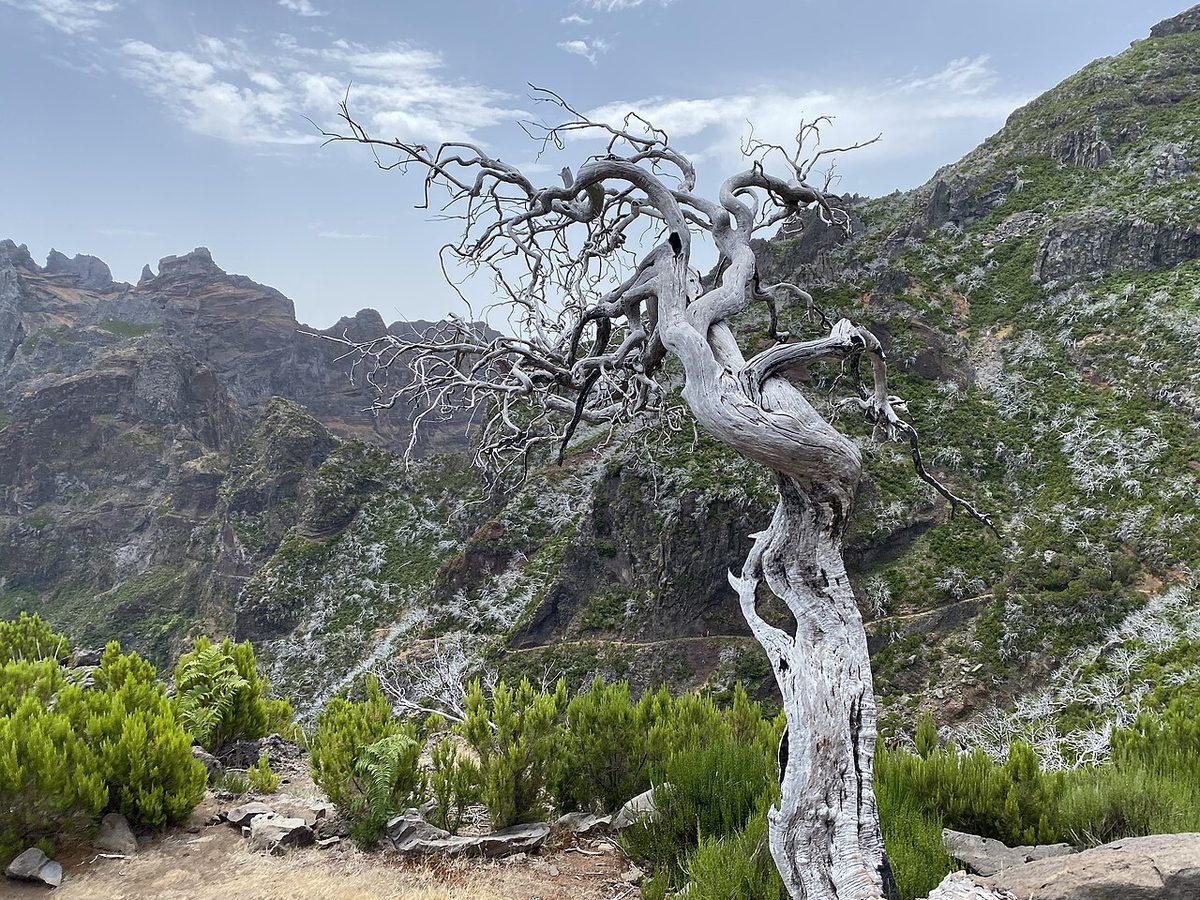
The short out-and-back from Arieiro to the Pedra Rija viewpoint is still possible, and it’s what most sunrise visitors do. The rules for walkers who only go that far have shifted as the trail reopened, so check on SIMplifica whether your plan needs a booking. As for what the fire left behind: the ridge is still spectacular, but you’ll walk through slopes of silvered, dead tree heath for long stretches, and some of the greenery in older photographs isn’t there any more. It’s regrowing, slowly.
What a levada actually is
When the Portuguese settled Madeira in the 1420s they found an island with its water in the wrong place. Clouds blowing off the Atlantic drop their rain on the steep, forested north and on the central mountains, while the sunny south, where the land was flat enough to farm and where the sugar cane that made the island rich would grow, stays comparatively dry. The answer was the levada: a narrow, gently sloping stone channel cut along the contours of the mountainside to carry water from the wet side of the island to the dry one.
The first were dug in the fifteenth century, and the network grew for five hundred years, through the sugar boom, the wine trade and into the twentieth century, when big state-built channels like the Levada dos Tornos (opened in the 1960s) were added to supply Funchal and generate hydroelectric power. There are now more than 2,000 km of them, many running through hand-cut tunnels. The early channels were cut by labourers, many of them enslaved, some lowered down cliff faces on ropes to chisel the channel out of the rock, and the human cost of that work is part of the story the pretty photographs leave out.
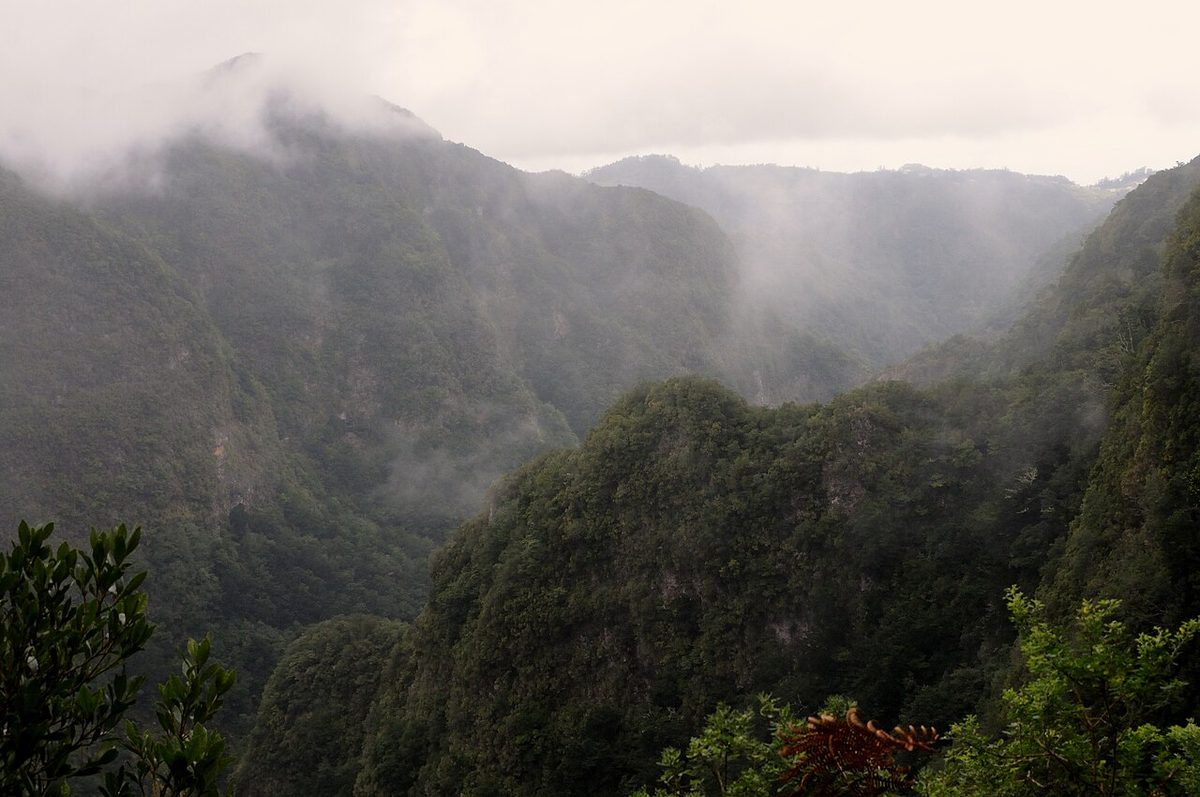
Alongside each levada runs a maintenance path for the levadeiros, the men who keep the channels clear and open and close the sluices that share water between farms. Because water has to flow slowly, the channels (and so the paths) are almost level, which is how you get a nearly flat walk across the side of a mountain, sometimes with a sheer drop on one side. Many of the best run through laurissilva, the ancient laurel forest that once covered much of southern Europe and now survives largely here. Madeira’s laurel forest has been a UNESCO World Heritage Site since 1999.
The levada walks, one by one
Levada do Caldeirão Verde (PR9)
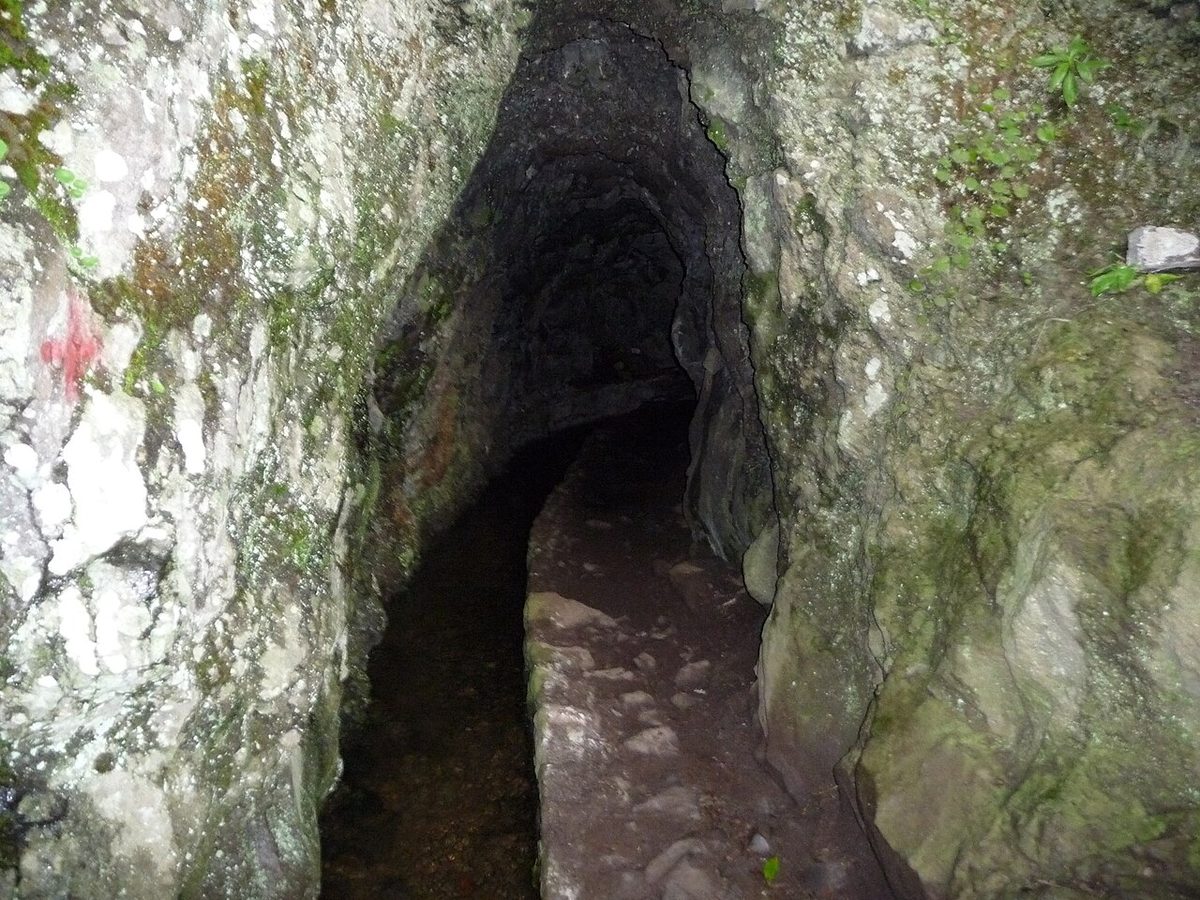
If you do one levada in Madeira, make it this one. The walk starts at the Parque Florestal das Queimadas, a forest park in the hills above Santana with a thatched ranger’s house by a pond, and follows the levada deep into the laurel forest. It clings to the side of steep valleys, goes through several low, dripping tunnels, and ends at the Caldeirão Verde, the “green cauldron”, where a waterfall drops more than a hundred metres into a pool inside a sheer bowl of moss and fern. Allow five to six hours for about 13 km there and back; the path is mostly level but long, uneven, muddy in places and narrow above drops in others. You need a head torch for the tunnels: a phone torch is not enough when you’re also watching your feet. The old continuation beyond the cauldron to the Caldeirão do Inferno has been closed for years, so don’t plan on it.
Getting there: by car to Queimadas, where the parking is limited and the last stretch of road is narrow, so arrive early; or by taxi from Santana. Booking: PR9, €4.50, and the slots go days ahead in summer. Verdict: the best levada walk on the island, and worth building a day around. Start at the first slot to get the tunnels and the cauldron before the crowds.
Levada das 25 Fontes and Levada do Risco (PR6 and PR6.1)
The walk everyone does, and for good reason. From the Rabaçal forestry house, in a valley below the Paul da Serra plateau, one levada leads to the Risco viewpoint, where a tall waterfall drops down a cliff opposite you (the path beyond the viewpoint is closed), and another leads further down the valley to the 25 Fontes, a pool fed by dozens of thin streams trickling down a mossy cliff. Doing both makes a walk of three to four hours, including the approach.
The access catch: the steep road from the ER110 down to the Rabaçal house is closed to private cars. You either take the shuttle minibus that runs from the ER110 car park, or walk the two kilometres of tarmac down, which is easy going, and back up again at the end, which is a slog. Parking at the Rabaçal car park on the ER110 is now charged; one 2026 trail site puts it at about €2 an hour, so check on arrival. Booking: PR6 and PR6.1 are separate trails at €4.50 each. The morning slots for PR6 are the most sought-after on the island after PR1. Verdict: go, but go early. At 11:00 in August the path to 25 Fontes is a queue, and the pool looks like a hotel lido. If you only have time for one of the pair, the Risco is short, easy and more dramatic.
Levada do Rei (PR18)
On the north coast, starting at Quebradas above São Jorge, the Levada do Rei follows a gentle channel through old laurel forest to the stream at Ribeiro Bonito, about five kilometres out, and back the same way. It has most of what makes Caldeirão Verde special, the forest, the moss, the water running beside you, with a fraction of the people and fewer difficult bits. There are some drops, but they’re mostly well guarded. Booking: PR18, €4.50. Verdict: my recommendation for anyone who wants the laurel-forest levada experience without the queue, or who finds Caldeirão Verde too long.
Vereda dos Balcões (PR11)
From the little settlement of Ribeiro Frio, on the mountain road between Funchal and the north coast, a short, level path follows a levada for about 1.5 km to the Balcões (“balconies”) viewpoint, which looks across a deep valley to the central peaks, Arieiro, Torres and Ruivo, on a clear day. Madeiran chaffinches are bold enough to take crumbs from your hand along the way. Ribeiro Frio also has a trout farm and a restaurant that serves it. Booking: officially €4.50 (though one tracker lists it as free, as noted above). Verdict: the best return on effort of any walk in Madeira: an hour, almost flat, and one of the biggest views on the island. It’s a good first walk to check how you feel about levadas.
Levada do Furado (PR10)
Also from Ribeiro Frio, the Levada do Furado runs east through dense forest to Portela, about 11 km one way. It’s a beautiful, long, forested levada with some narrow sections. It has been closed at times for repairs, and one tracker listed it as closed in September 2026, so check its status on SIMplifica before you plan around it. Verdict: an excellent full day when it’s open, and the natural next step after Balcões.
Levada dos Tornos
Above Funchal, the Levada dos Tornos is one of the island’s great twentieth-century channels, and the stretch between the Monte area and Camacha makes a gentle, mostly easy walk through woods and gardens with views down over the city. It isn’t a PR trail, so there’s no booking. It’s the easiest levada to reach without a car, and a good introduction on your first day. Its edges are also more suburban, so it won’t feel wild. Verdict: the easy half-day from Funchal; not a substitute for the forest walks in the north.
Vereda do Fanal (PR13) and the fog forest
Fanal, on the north-western edge of the Paul da Serra plateau, is a grassy clearing dotted with ancient, gnarled til trees, a kind of laurel, that are hundreds of years old. The PR13 walk links it with Estanquinhos on the plateau, about 11 km. Many people simply drive to Fanal and wander among the trees. The trick is to go on a foggy day, which is precisely when everyone else stays away: in cloud, the trees loom out of the grey like something from a fairytale, and it becomes the most atmospheric place on the island. On a bright sunny day it’s pleasant and a bit ordinary. Verdict: the one place in Madeira where bad weather improves the experience.
Peaks, ridges and the east
Pico do Arieiro to Pico Ruivo (PR1)
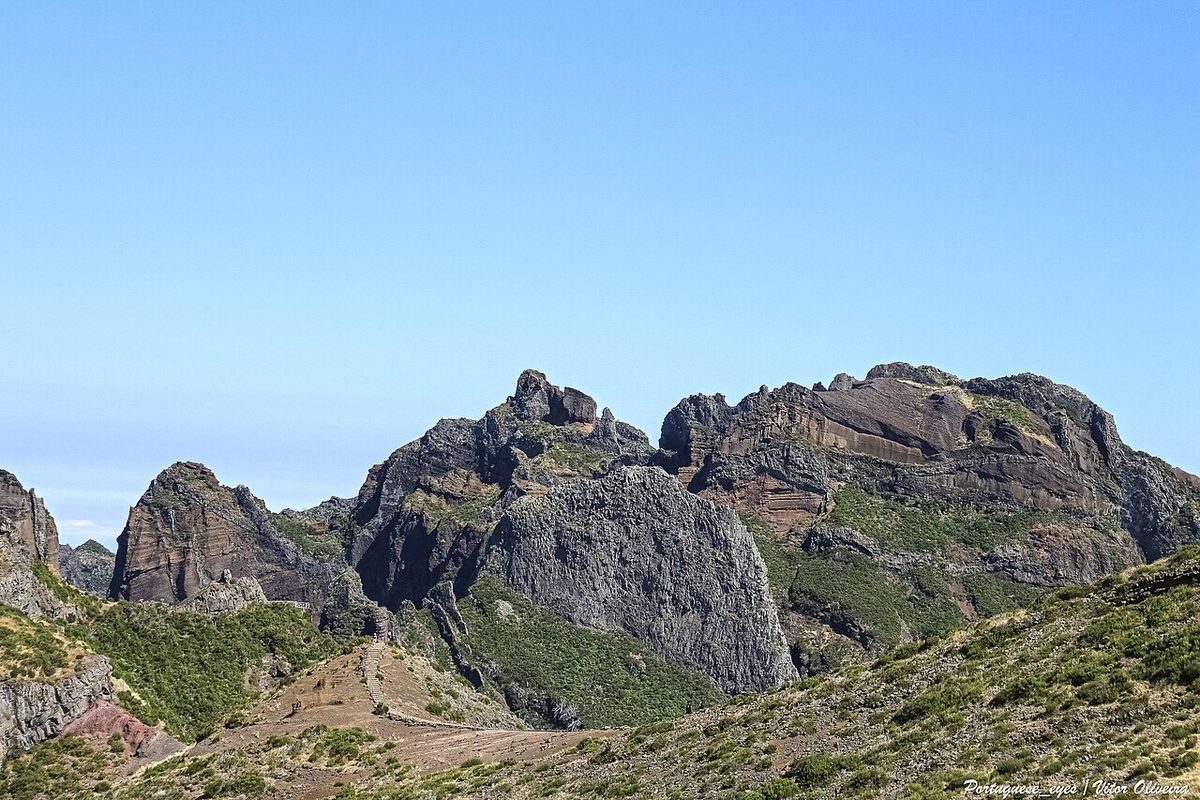
The spine of the island between its third-highest peak, Pico do Arieiro at 1,818 m, and its highest, Pico Ruivo at 1,862 m, is the most spectacular walk in Portugal. The path is carved into the rock with staircases, fenced ledges and tunnels, it passes below Pico das Torres, and very often you’re walking above a sea of cloud with the valleys hidden beneath you. It isn’t a levada. It’s a proper mountain path with sustained climbs and descents, exposure in places, and no shelter until the refuge below Pico Ruivo.
Time: allow four to five hours from Arieiro to Ruivo and down to Achada do Teixeira, plus the transfer back. Booking: €10.50, with thirty-minute slots; since the April 2026 reopening it’s one-way beyond Pedra Rija (see above). Verdict: do it, early, on the first clear morning you have, not on a day fixed months ahead, if the slot system allows. Don’t attempt it in high wind, rain or thick cloud, and carry water, food and a head torch for the tunnels.
Pico Ruivo from Achada do Teixeira (PR1.2)
The easy way up the island’s highest mountain. From the car park at Achada do Teixeira, above Santana, a paved path climbs about 2.8 km to the summit of Pico Ruivo, passing a mountain refuge near the top. It’s steady uphill but not difficult, and in good weather the view from the top takes in most of the island. Allow two to two and a half hours there and back. Booking: €4.50. Verdict: the right choice for anyone who wants the summit without PR1’s exposure or logistics, and a great sunset walk if you’re careful about the descent in failing light.
Ponta de São Lourenço (PR8)
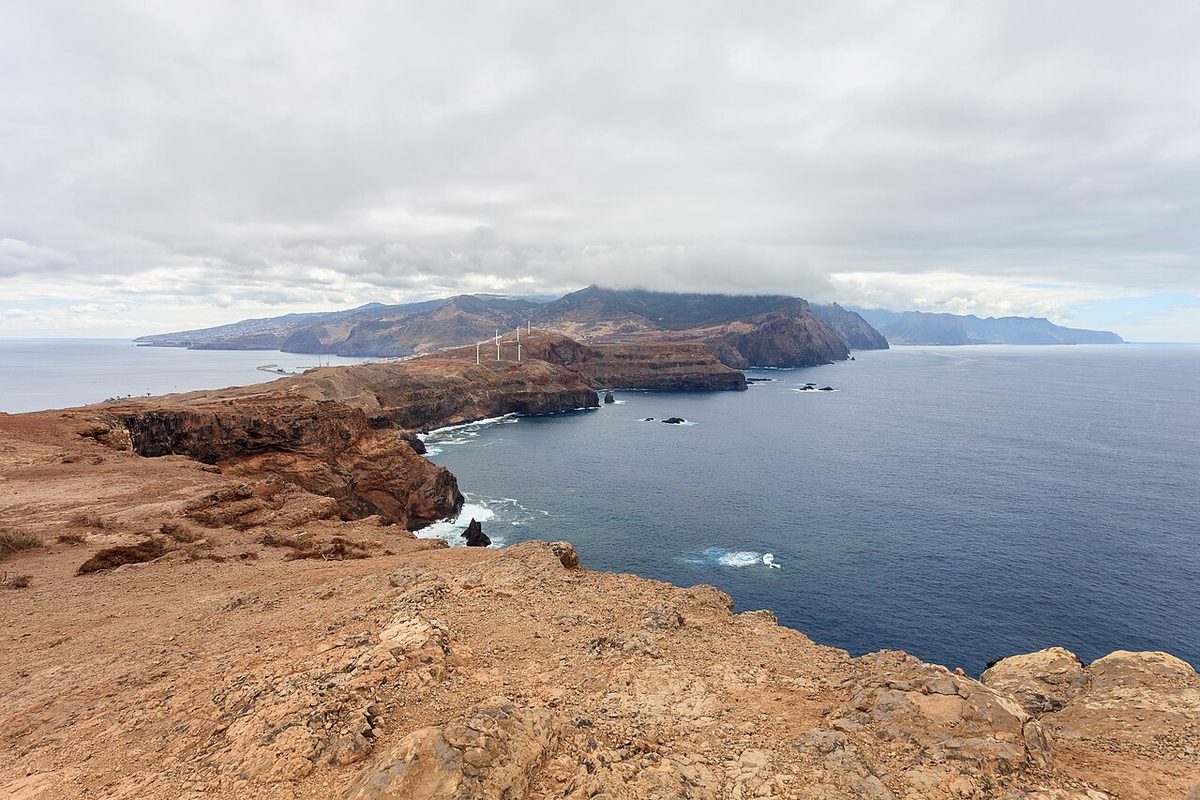
The eastern tip of Madeira is a long, narrow peninsula of bare red, ochre and black volcanic rock with almost no trees, a landscape so unlike the rest of the island that it feels like a different country. The path runs from the car park at Baía d’Abra, past Caniçal, along the ridge and across a narrow neck of land with sea on both sides, to the Casa do Sardinha, a warden’s house among palm trees with a small snack bar, about three kilometres out. From there you can climb to the viewpoint on Pico do Furado for the view to the end of the peninsula and the Desertas islands beyond. Allow two and a half to three and a half hours.
Booking: PR8, €4.50. Warnings: there’s no shade at all, it’s often very windy, and on a hot day it’s hard work in the middle of the day. Verdict: an essential contrast to the forest walks, and the best walk on the island when the north and the mountains are in cloud, because the east is the driest part of Madeira.
Which walk for which walker
| If you are… | Walk this | Skip this |
|---|---|---|
| A first-time or nervous walker | PR11 Balcões, Levada dos Tornos, the Risco (PR6.1) | PR1, PR9 until you’ve tried a shorter levada |
| A family with children | Balcões, the Risco waterfall, the first few kilometres of the Levada do Rei | Any walk with long exposed drops |
| Uneasy with heights | Levada do Rei, Balcões, Fanal | PR1, parts of PR9, the unfenced unofficial levadas |
| A strong walker with a week | PR1, PR9, PR6 + PR6.1, PR8, PR18, and a Fanal fog day | Levada dos Tornos |
| Walking in winter | PR8 São Lourenço, the southern levadas above Funchal | The high peaks in storms; check closures daily |
| Staying in Funchal without a car | Levada dos Tornos, guided PR1 and PR9 with transport | Trying to reach Queimadas or Rabaçal by bus |
Vertigo, tunnels and exposure: an honest guide
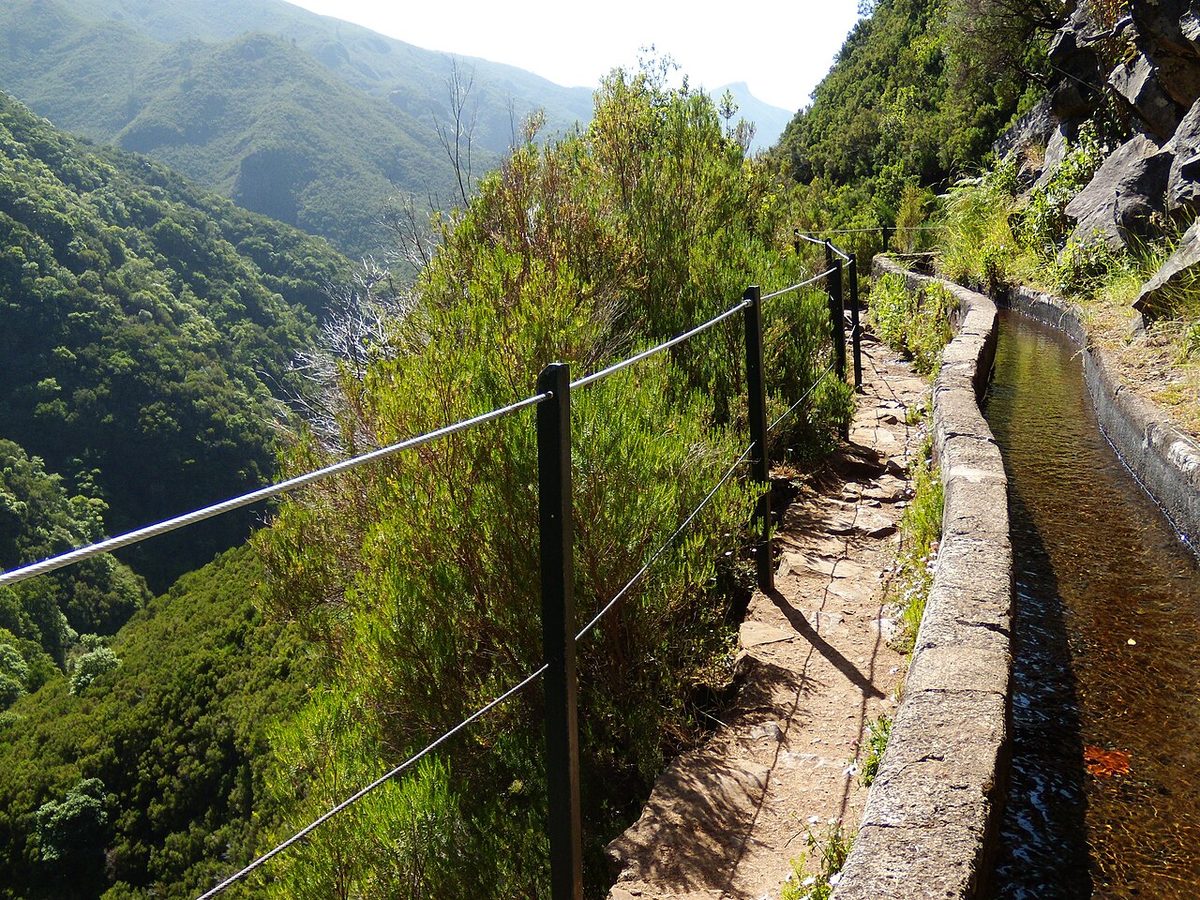
Levadas have a reputation for being gentle, and it’s half true. The gradient is gentle, because water can’t flow uphill. The edges are another matter. Many levada paths are a single boot wide, run along the top of the channel wall, and have a drop on the valley side that ranges from a few metres to hundreds. On the popular official routes the worst sections have cable railings, like the one on the way to 25 Fontes. On the unofficial ones there’s often nothing.
Here’s how the main walks rate for exposure, based on how they’re usually described and what the operators warn about. Balcões and Levada do Rei: low, with a few guarded sections. 25 Fontes and Risco: moderate, with some narrow edges, mostly railed. Caldeirão Verde: moderate to high, with long narrow sections, some unguarded drops and several low tunnels where you’ll stoop and walk in water. PR1: high, with ledges and staircases above big drops, fenced in the worst places but serious in wind. São Lourenço: low on the path, but you’re on cliff edges at the viewpoints, and the wind is the hazard.
The tunnels deserve a word of their own. Several walks, PR9 and PR1 above all, pass through tunnels that are unlit, low and wet, where the path runs along the edge of the water channel. A head torch leaves both hands free for the walls; take one and a spare battery. If you’re claustrophobic, the longest tunnels are the part of the walk to think hardest about.
Walks by region, with drive times from Funchal
Madeira is only about 57 km long, but its roads climb and twist, so distances on a map mislead. It helps to think of the walks in five groups, and to plan one group per day. The drive times below are typical from central Funchal in normal traffic. They’re approximate, and you should add a margin on top to make a thirty-minute booking slot.
| Region | Walks | Drive from Funchal | Notes |
|---|---|---|---|
| Central peaks | PR1 from Pico do Arieiro; PR1.2 from Achada do Teixeira | ~45 min to Arieiro; ~1 h to Achada do Teixeira | Cold at dawn; the two ends are about an hour apart by road |
| North-east forest | PR9 from Queimadas; PR18 from Quebradas; PR11 and PR10 from Ribeiro Frio | ~35–40 min to Ribeiro Frio; ~1 h to Queimadas and Quebradas | The wettest walks; pair them with a night in Santana |
| West and Paul da Serra | PR6 and PR6.1 from Rabaçal; PR13 Fanal | ~1 h to Rabaçal; ~1h15 to Fanal | Fog on the plateau; paid parking and a shuttle at Rabaçal |
| East | PR8 Ponta de São Lourenço; the Levada do Caniçal | ~40 min | Driest and sunniest, often very windy |
| Above Funchal | Levada dos Tornos | 20–30 min | No booking; the easiest to reach by bus or taxi |
The practical lesson is not to pair walks from opposite ends of the island. Rabaçal in the morning and São Lourenço in the afternoon means three hours in the car and at least one walk at the wrong time of day. Rabaçal and Fanal fit together, as do Ribeiro Frio and Queimadas, or PR8 with the Levada do Caniçal.
That last one is worth knowing about. The Levada do Caniçal is an unofficial, gentle levada running from the Maroços valley above Machico towards Caniçal, a level walk through farmland and woods on the sunny side of the island. It isn’t a PR trail and needs no booking. It’s more pastoral than wild, but it’s a sensible choice on a day when the north is wet.
How long each walk really takes, door to door
| Walk | Walking time | Round-trip driving from Funchal | Realistic share of the day |
|---|---|---|---|
| PR1 with the PR1.2 descent | 4–5 h | ~1h45, plus the transfer between the two ends | A full day |
| PR9 Caldeirão Verde | 5–6 h | ~2 h | A full day |
| PR6 and PR6.1, Rabaçal | 3–4 h including the road down | ~2 h, plus the shuttle | Most of a day; Fanal fits afterwards |
| PR18 Levada do Rei | 3–4 h | ~2 h | Most of a day |
| PR8 São Lourenço | 2.5–3.5 h | ~1h20 | Half a day |
| PR1.2 to Pico Ruivo only | 2–2.5 h | ~2 h | Half a day |
| PR11 Balcões | 1 h | ~1h15 | Half a day with lunch at Ribeiro Frio |
| Levada dos Tornos | 2–4 h | ~50 min | Half a day |
Sunrise at Pico do Arieiro, and the PR1 car problem solved
The road runs right to the summit of Pico do Arieiro, which is why it’s the island’s sunrise spot: on a good morning the sun comes up over a flat sea of cloud with the peaks standing out of it like islands. Arrive at least forty-five minutes before sunrise if you want to park near the top, because the car park fills before first light. At 1,818 m it’s cold before dawn in every season, and close to freezing on winter mornings, so bring a proper warm jacket, a hat and gloves even if Funchal was balmy when you left. Check a live webcam first. Sometimes the cloud isn’t below the summit at all but on top of it, and you’ll see nothing.
If you’re walking PR1, the one-way rule turns the sunrise into a logistics puzzle, and there’s a neat solution. Drive to Achada do Teixeira, the finish, the night before or before dawn, park there, and take a pre-booked taxi from there to Arieiro for sunrise. Book the first PR1 slot after sunrise, watch the light, walk the ridge to Pico Ruivo and descend by the PR1.2 to your own car. You’re never waiting on a pickup at the end of a long day, and you finish when you finish. The alternative, parking at Arieiro and booking a taxi pickup at Achada do Teixeira, works too, but you’ll be watching the clock on the ridge.
A bad-weather plan
Madeira’s weather is local, and the island almost never has the same weather everywhere at once. When the north coast and the peaks are in cloud and drizzle, the south coast and the eastern tip are often dry. On a bad day, the first choice is the east: PR8 at São Lourenço and the Levada do Caniçal sit on the driest part of the island. The second is the levadas above Funchal, the Levada dos Tornos above all, which are sheltered and low enough to stay under the cloud.
What not to do: drive up to Arieiro in cloud hoping it will clear (it sometimes does, but PR1 in wind and rain is dangerous and pointless); walk PR9 after heavy rain, when the waterfalls are spectacular but the path is slippery and the risk of rockfall goes up; or walk anything that’s been officially closed. Check SIMplifica’s terms on changing or cancelling a booking before you pay, since weather is the most likely reason you’ll want to. It’s another reason the multi-day passes make sense for a walking holiday. And if the whole island is under cloud, take the day off: Funchal’s old town, the markets and the cable car to Monte are covered in our Madeira guide.
Walking Madeira with children
Children under twelve walk the PR trails free, but they still have to be named on the booking, so add them when you reserve. The best walks for families are the short, level ones with a pay-off at the end: the Vereda dos Balcões (an hour, with chaffinches that come to your hand and the trout farm at Ribeiro Frio at the start), the Risco waterfall from Rabaçal, the first few kilometres of the Levada do Rei, the old trees at Fanal, and sections of the Levada dos Tornos above Funchal.
Leave PR1 for older, confident children only, because of its length, stairs and exposure, and think hard about PR9 with young children: it’s long, the tunnels are low and wet, and some sections are narrow above drops. On any levada, hold hands on the narrow bits and walk with the child on the mountain side. Give each child a torch for tunnels, which turns the scary part into the fun part. Carrying a baby in a backpack is awkward on narrow paths with low tunnels, so choose the wider walks. Take more snacks than you think you’ll need, because there’s nowhere to buy anything.
Walking without a car
You can walk well in Madeira without a car, but you have to choose the walks with that in mind. From Funchal, the Levada dos Tornos is reachable by bus or a short taxi ride to the Monte or Camacha side, and the Monte cable car (€16 one way, €22 return, checked September 2026) is a car-free way up the hill for the Monte end. For the big walks, the realistic options are a guided walk with transport, which also gets you the lower protocol permit rate, or a taxi on a fixed-price trailhead drop and pickup, agreed in advance. Madeira’s taxi drivers are used to both. Buses reach Ribeiro Frio, Santana and the Caniçal side of the island, but their timetables rarely match a morning booking slot and an afternoon finish, so check the return times before you rely on them. If you’re coming to Madeira specifically to walk and don’t drive, I’d base yourself in Funchal and book two or three guided days for PR1, PR9 and Rabaçal, then walk the rest from town.
Levada etiquette
- Walk single file on narrow sections, and when you meet people, the one who waits should step to the mountain side and let the other pass. Never wait on the drop side.
- Don’t walk in the channel, dam it or wash in it. The water is somebody’s irrigation and sometimes somebody’s drinking supply further down the line.
- Give way to the levadeiros working on the channels. It’s their path first.
- Take all your litter out. There are no bins on the trails, and the laurel forest is a protected World Heritage Site.
- Don’t pick plants or take cuttings, however common they look.
- Keep to your slot. The whole point of the booking system is to spread walkers through the day, and turning up hours early or late defeats it.
- Check the rules before flying a drone in protected areas, and don’t fly one over other walkers on narrow paths.
Getting to the trailheads
By car: by far the easiest. Madeira’s expressway (the VR1) runs along the south coast, and fast tunnelled roads cross to the north. Beyond them, the mountain roads to trailheads are steep, narrow and slow, so leave more time than the map suggests, especially to make a thirty-minute booking slot. The Pico do Arieiro car park fills before sunrise; Queimadas has limited space and a narrow final road; Rabaçal means paying to park on the ER110 and then taking the shuttle or walking down; Baía d’Abra has a large car park at the end of the road; Ribeiro Frio has roadside parking.
By bus: Madeira has three main bus companies, serving Funchal and the island’s east and west, but their timetables are built for commuters, not for walkers wanting a 08:30 start at a remote trailhead. Buses can get you to Ribeiro Frio, to Santana (then a taxi to Queimadas), and out towards Caniçal and the São Lourenço road, but check return times before you commit. Rabaçal, Fanal and Arieiro are, in practice, car or taxi only.
By taxi: Madeira’s taxis will do fixed-price trailhead drops and pickups, and for PR1’s one-way traverse a pre-arranged pickup at Achada do Teixeira is the standard solution. Agree the price when you book. For more on car hire, driving and the island’s roads, see our guide to getting around Portugal.
Guided or self-guided?
Most levadas don’t need a guide: the official trails are waymarked, well trodden and hard to get lost on in clear weather. There are three cases where I’d pay for one. PR1, because the one-way rule makes the transport awkward, and a guided walk solves it and gets the lower protocol permit rate. Walking without a car, because a guided walk with transport from Funchal is cheaper and less stressful than taxis at both ends. And nervous walkers, because a good guide will pick the right walk for your head for heights and turn you round if the weather goes. Protocol operators pay around €3 per person per trail (about €7 for PR1) instead of the individual €4.50 and €10.50, although you’ll pay the operator a good deal more than that for the guiding itself.
When to walk: seasons, weather and fire closures
Madeira is mild all year: Funchal’s average high runs from about 20 °C in January to about 27 °C in August, with around 575 mm of rain a year. But Funchal isn’t where you’re walking. The north side of the island and the mountains get far more rain and cloud, the Paul da Serra plateau is regularly lost in fog, and temperatures on the peaks can be near freezing on winter nights.
| Season | Walking conditions | Watch out for |
|---|---|---|
| April–June | My pick: green, flowering, mild, long days | Showers; morning cloud on the north coast |
| July–August | Warm and driest; high routes most reliable | Crowds, sold-out slots, heat on PR8, fire-risk closures |
| September–October | Excellent: warm, quieter, clear mornings | First autumn rains in late October |
| November–March | Mild on the coast, possible on many routes | Storms, landslides and trail closures; cold and ice on the peaks |
Two kinds of closure can cancel your walk at short notice. In storms and heavy rain the authorities close trails because of rockfall and landslips, and after big storms some stay closed for weeks. In summer, trails in the high forest can be closed on days of high fire risk; after 2024, nobody on the island takes that lightly. Check trail status on SIMplifica or the regional forestry service’s pages the evening before and again in the morning, and don’t walk a closed trail. As for time of day, walk in the morning: cloud builds over the mountains and the north coast from late morning on most days, and the best views are early. For how Madeira compares with the mainland month by month, see our best time to visit Portugal guide.
Booking-day mistakes to avoid
The SIMplifica system is simple once you’ve used it, but a few mistakes come up again and again in the first year of the scheme.
- Booking one trail when you’re walking two. PR6 (25 Fontes) and PR6.1 (Risco) share a start and are usually walked together, but they’re separate trails with separate fees. The same goes for PR1 and the PR1.2 descent to Achada do Teixeira, so check what your route actually covers.
- Forgetting the children. Under-12s are free but must be named on the booking. An unnamed child is an unbooked walker.
- Getting the time wrong. Madeira keeps the same time as Lisbon and the UK. Walkers arriving from central Europe or connecting through Spain sometimes book a slot an hour out.
- Treating the slot as a suggestion. It’s a thirty-minute entry window. Don’t count on being let in long after it closes, and plan the mountain drive backwards from it.
- Relying on a signal at the trailhead. Many trailheads are in deep valleys or on high plateaus with patchy coverage. Screenshot the confirmation before you leave the hotel.
- Booking the whole week in advance. Book the scarce slots (PR1 and PR6 mornings) early. Leave the rest until you’ve seen the forecast, or buy a pass that lets you shuffle days.
Waymarks, rescue and insurance
The official trails are signed in the standard Portuguese way for short routes: a yellow stripe above a red one means you’re on the path, a yellow-and-red cross means wrong way, and bent stripes show a turn. Wooden signposts with the PR code and an information panel mark each start. In clear weather you’d have to work hard to get lost on a levada, because the channel is the route. On the high ground and in fog, the waymarks matter, and it’s worth downloading an offline map before you set off.
The emergency number is 112, as everywhere in Portugal and the EU. Before a long or high walk, tell someone at your hotel which trail you’re on and when you expect to be back, and carry a charged phone even though the signal comes and goes. Check that your travel insurance covers hiking and mountain rescue, including helicopter evacuation. Most standard policies cover waymarked walking, but some exclude “trekking” above a certain altitude, and Pico Ruivo is 1,862 m. Read the small print before you book PR1.
What to pack
- A head torch, with a spare battery, for the tunnels on PR9, PR1 and others.
- Shoes with real grip. Levada walls are wet, mossy and polished by thousands of boots. Trail shoes or light boots, not fashion trainers.
- A waterproof and a warm layer, even in August. It can be 25 °C in Funchal and 10 °C and wet at Pico do Arieiro on the same morning.
- Water and food. Apart from the Casa do Sardinha on São Lourenço and the odd trailhead café, there’s nothing to buy on the walks.
- Your booking confirmation, on your phone and screenshotted, because signal in the valleys is patchy.
- Sun protection for PR1 and PR8, where there’s no shade.
- Cash for trailhead shuttles, parking machines and cafés that don’t take cards.
A five-day Madeira walking plan
| Day | Walk | Why this order |
|---|---|---|
| 1 | Arrive; Levada dos Tornos above Funchal in the afternoon | An easy first walk with no booking, close to the airport and the city |
| 2 | PR1 Arieiro to Ruivo on the first clear morning, early slot, pickup at Achada do Teixeira | The weather-dependent walk comes first so you have days to move it |
| 3 | PR9 Caldeirão Verde from Queimadas, first slot; lunch in Santana | A long forest walk the day after the ridge, when your legs want level ground |
| 4 | PR6.1 Risco and PR6 25 Fontes from Rabaçal early; Fanal in the afternoon if it’s foggy | The west in one day; Fanal is ten minutes’ drive further on |
| 5 | PR8 São Lourenço in the morning; PR11 Balcões on the way back if you have energy | The dry east for the last day, near the airport |
With a seven-day pass (€52.50) you could book this flexibly and still have two days in hand for the Levada do Rei and the Pico Ruivo summit from Achada do Teixeira. For everything else on the island, from Funchal’s old town to the north-coast pools at Porto Moniz, see our complete Madeira travel guide.
Where to eat and drink after a walk
Part of the pleasure of a walking day in Madeira is what comes at the end of it. At Ribeiro Frio, the restaurant beside the trout farm serves the fish you’ve just watched in the tanks, which makes it the obvious lunch after the Balcões or the Levada do Furado. On the road between Funchal’s side of the island and Rabaçal, the village of Serra de Água, below the Encumeada pass, is known for its poncha bars. Poncha is Madeira’s drink of sugar-cane rum, honey and lemon, stirred with a wooden stick, and the famous one is a raucous taberna that’s been serving it for decades. Have one after the walk, not before the drive, and let someone else drive if you have two. On the north coast, Santana has its triangular thatched houses and several restaurants that feed PR9 and Pico Ruivo walkers. Wherever you end up, order espetada, beef on a bay-wood skewer, with bolo do caco, the flat garlic-butter bread you’ll crave by the end of the week. Our guide to Portuguese food has more on both.
Where to base yourself for walking
| Base | Good for | Downside |
|---|---|---|
| Funchal | Restaurants, transport, guided-walk pickups, Levada dos Tornos | An hour or more from Rabaçal and Queimadas; early starts |
| Santana and the north coast | PR9, PR1.2, PR18, and PR1 finishes at Achada do Teixeira | Wetter, cloudier and quieter in the evenings |
| Calheta, Ponta do Sol and the south-west | Rabaçal, Paul da Serra, Fanal, sunshine | Far from the east and the central peaks |
| Machico or Caniço | PR8, the airport, sunnier east | A long way from the western walks |
A walking week splits well into three or four nights in Funchal or the south-west and two or three on the north coast around Santana. That cuts the early-morning drives for PR9 and the Pico Ruivo walks roughly in half.
What to skip, and what’s overrated
25 Fontes at 11:00 in summer. The walk is lovely, but at that time of day it’s a single-file queue, and the pool at the end is crowded. Take the first slot or do the Risco only.
PR1 sunrise as a social-media event. The Arieiro car park at dawn is full of people filming the same sunrise. It’s beautiful, but if you’re walking PR1, the ridge an hour later with fewer people is better. The viewpoint isn’t the walk.
Unofficial levadas behind closure signs. Some of the famous “secret” levadas that circulate online are closed, unmaintained or on private water channels. Every year walkers are rescued from paths they shouldn’t have been on. Stick to the official routes unless you’re experienced, and never pass a closure.
The idea that levadas are easy because they’re flat. They’re level, not easy. A 13 km walk on a narrow, uneven, wet path with drops beside you is tiring, and many people underestimate PR9.
The Caldeirão do Inferno. It still appears in older guides as the continuation of PR9. It’s been closed for years.
Paying a tour to do Balcões. It’s an hour’s flat walk from a roadside car park. Save the guide for PR1.
Trying to walk every day. The island’s weather will beat that plan. Four walking days in a week, with rest days that double as weather days, gives you a better trip than seven fixed bookings.
Madeira or the Azores for walking?
Portugal’s two Atlantic archipelagos are both walkers’ islands, in different ways. Madeira is steeper, more dramatic and better organised, with the levadas, the high ridge and a booking system that’s now strictly enforced. The Azores are gentler and greener, with crater lakes and a more rural feel, spread across nine islands, including the climb up Pico, Portugal’s highest mountain at 2,351 m. If you’re choosing, Madeira has the better single week of walking and the Azores the better long, slow trip. For the Azores, see our guide to the Azores islands and our São Miguel guide, whose crater-rim walk at Sete Cidades is the Azorean answer to PR1.
Frequently asked questions
Do you need to book levada walks in Madeira?
Yes, for any official PR trail. Since 1 January 2026, all of them need an online booking on simplifica.madeira.gov.pt with a thirty-minute entry slot. Unofficial levada paths aren’t part of the system, but they’re also not maintained as official routes.
How much does it cost to walk a trail in Madeira in 2026?
€4.50 per person per trail, and €10.50 for PR1, Pico do Arieiro to Pico Ruivo (checked September 2026). A 3-day pass is €22.50 and a 7-day pass €52.50; children under 12 are free but must be named. Licensed operators pay a lower rate of around €3 per trail.
What is the best levada walk in Madeira?
The Levada do Caldeirão Verde (PR9), for the laurel forest, the tunnels and the waterfall at the end. For a shorter walk, the 25 Fontes and Risco pair (PR6 and PR6.1) is the classic, and for peace and quiet the Levada do Rei (PR18) is my pick.
What is the easiest levada walk in Madeira?
The Vereda dos Balcões (PR11) from Ribeiro Frio: about 1.5 km each way, nearly flat, and ending at a big viewpoint. The Levada dos Tornos above Funchal and the short Levada do Risco are also easy.
Is the PR1 Pico do Arieiro to Pico Ruivo trail open?
Yes. It reopened on 27 April 2026 after about twenty months of reconstruction following the August 2024 wildfire. Beyond the first 1.2 km, from Arieiro to the Pedra Rija viewpoint, it’s now one-way from Arieiro to Ruivo, so you’ll need transport back from Achada do Teixeira.
Can you walk PR1 from Pico Ruivo to Pico do Arieiro?
No, not since the April 2026 reopening. The section beyond Pedra Rija is one-way from Arieiro towards Ruivo. To start at the Ruivo end, climb Pico Ruivo from Achada do Teixeira on the PR1.2 and come back the same way.
Are levada walks dangerous?
The popular official routes are safe for sensible walkers in good weather, but many have narrow paths with drops on one side, wet surfaces and low tunnels. The risks come from bad weather, closed or unofficial paths, poor footwear and walking in cloud. Choose a walk that suits your head for heights, and turn back if conditions change.
Do you need a torch for levada walks?
For several of them, yes. The Caldeirão Verde (PR9) and the PR1 both pass through unlit tunnels. A head torch is better than a phone torch because it leaves your hands free.
When is the best time of year for hiking in Madeira?
April to June and September to October. July and August are the most reliable for the high routes but the busiest, with a risk of fire-related closures. Winter is mild on the coast, but storms close trails and the peaks can be cold and icy.
Do you need a guide to walk in Madeira?
Not for most levadas, which are waymarked and well walked. A guide makes the most sense for PR1, where the one-way rule means arranging transport, and if you don’t have a car.
If Madeira gives you the walking bug, the mainland has plenty more. Our guide to hiking in Portugal picks the 20 best walks across the country and the Azores, from the Fishermen’s Trail’s clifftops to the glacial valley of the Serra da Estrela, with the permits that apply in 2026.
Where to go next
- Things to do in Madeira beyond the trails: Funchal, the north coast, the cable car and the food
- The Azores, Portugal’s other walking archipelago
- Portuguese food, including Madeira’s espetada and bolo do caco for after the walk
- What a trip to Portugal costs, islands included
- Portugal travel tips for your first visit
- The best of Portugal, from Lisbon to the Algarve
Photo credits
- Levada path with cable railing on the way to 25 Fontes (featured image) — anagh, CC BY-SA 3.0, via Wikimedia Commons
- Laurel forest from the Levada do Caldeirão Verde — Josep M. Gracia, CC BY-SA 4.0, via Wikimedia Commons
- Tunnel on the Levada do Caldeirão Verde — Pásztörperc at Hungarian Wikipedia, CC BY-SA 3.0, via Wikimedia Commons
- Path to Pico Ruivo — antony_hap, CC BY-SA 4.0, via Wikimedia Commons
- Ponta de São Lourenço — Luis Miguel Bugallo Sánchez (Lmbuga), CC BY-SA 4.0, via Wikimedia Commons
Trail fees, the booking rules and the PR1 reopening checked September 2026 against SIMplifica and two independent trail-status sites; distances and times are approximate. Trail status in Madeira changes with the weather, so check each trail on SIMplifica the day before you walk. Last updated: September 2026.